Keyword Author: layered materials

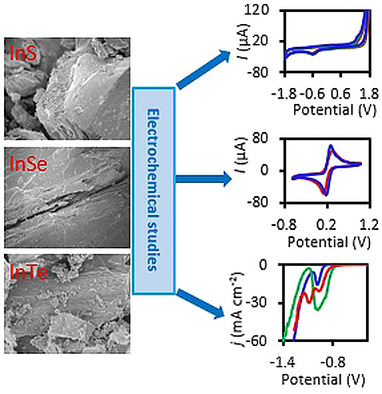
Electrochemistry of Layered Semiconducting A(III)B(VI) Chalcogenides: Indium Monochalcogenides (InS, InSe, InTe)

Layered A(III)B(VI) chalcogenides represent an interesting class semiconductors, where most of adopting 2D structures. Unlike the typical sandwiched structure of transition metal dichalcogenides (TMDs), layered A(III)B(VI) chalcogenides like InSe and GaSe are composed of X-M-M-X motif where M is gallium/indium and X is sulfur/selenium/tellurium. The exception is InS, which adopt an orthorhombic 3D structure. Herein, …

Electrochemistry of Layered Semiconducting A(III)B(VI) Chalcogenides: Indium Monochalcogenides (InS, InSe, InTe) Read More »

Edge vs. basal plane electrochemistry of layered pnictogens (As, Sb, Bi): Does edge always offer faster electron transfer?

Materials with layered structure are at the forefront of material research. Graphite, MoS2 and black phosphorus, as layered materials, exhibit, in general, fast heterogeneous transfer at the edge planes and slow at the basal plane for many electroactive molecules. There is a fundamental question whether this is general behaviour of layered materials. Here, we examined fundamental …

Edge vs. basal plane electrochemistry of layered pnictogens (As, Sb, Bi): Does edge always offer faster electron transfer? Read More »

Two-Dimensional Materials on the Rocks: Positive and Negative Role of Dopants and Impurities in Electrochemistry

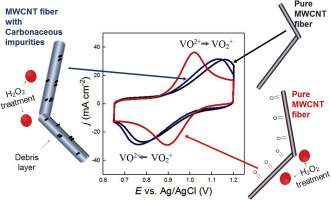
Two-dimensional (2D) materials, such as graphene and transition-metal chalcogenides, were shown in many works as very potent catalysts for industrially important electrochemical reactions, such as oxygen reduction, hydrogen and oxygen evolution, and carbon dioxide reduction. We critically discuss here the development in the field, showing that not only dopants but also impurities can have dramatic …

Two-Dimensional Materials on the Rocks: Positive and Negative Role of Dopants and Impurities in Electrochemistry Read More »

Cytotoxicity of Shear Exfoliated Pnictogen (As, Sb, Bi) Nanosheets

The experimental achievement of phosphorene, which exhibits superior electronic, physical, and optical properties has spurred recent interest in other Group 15 elemental 2D nanomaterials such as arsenene, antimonene, and bismuthene. These unique and superior properties of the pnictogen nanosheets have spurred intensive research efforts and led to the discovery of their diversified potential applications; for …

Cytotoxicity of Shear Exfoliated Pnictogen (As, Sb, Bi) Nanosheets Read More »

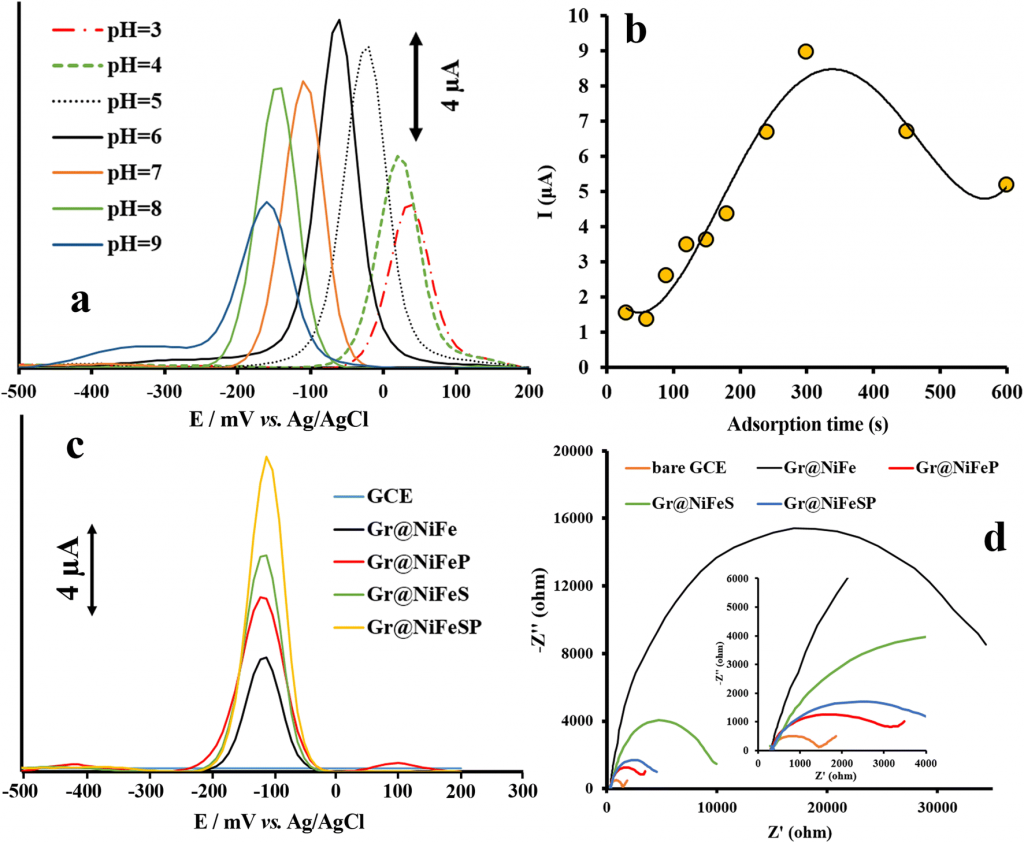
Pnictogen-Based Enzymatic Phenol Biosensors: Phosphorene, Arsenene, Antimonene, and Bismuthene

Two-dimensional materials have allowed for great advances in the biosensors field and to obtain sophisticated, smart, and miniaturized devices. In this work, we optimized a highly sensitive and selective phenol biosensor using 2D pnictogens (phosphorene, arsenene, antimonene, and bismuthene) as sensing platforms. Exfoliated pnictogen were obtained by the shear-force method, undergoing delamination and downsizing to …

Pnictogen-Based Enzymatic Phenol Biosensors: Phosphorene, Arsenene, Antimonene, and Bismuthene Read More »

Covalent Functionalization of Exfoliated Arsenic with Chlorocarbene

Few-layer and monolayer arsenic (arsenene) materials have been attracting great attention mainly from a theoretical perspective. Chemical modification of these materials would expand significantly the range of their applications. Here, we describe a chlorocarbene-mediated modification of exfoliated layered arsenic materials. Carbene-based species are highly reactive and offer further possibilities of functionalization. Our approach for modifying …

Covalent Functionalization of Exfoliated Arsenic with Chlorocarbene Read More »

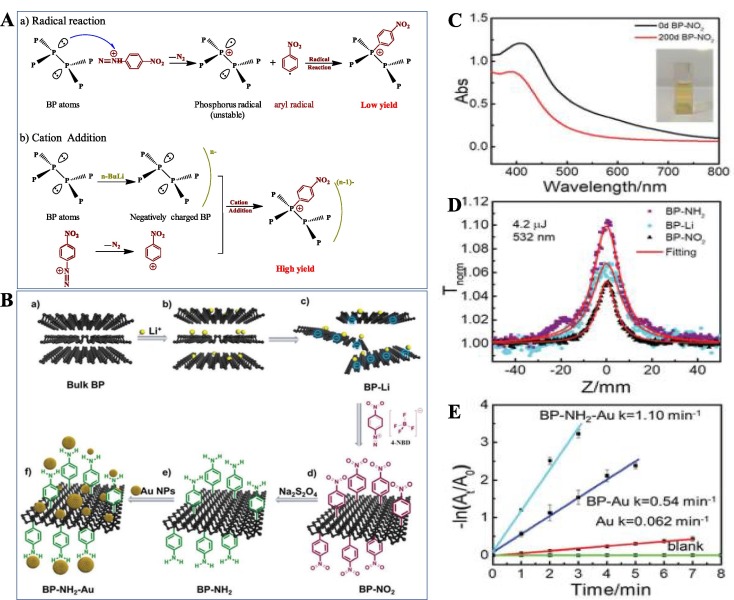
Functional Protection of Exfoliated Black Phosphorus by Noncovalent Modification with Anthraquinone

Few and monolayer black phosphorus (phosphorene) is currently an intensively researched material. Shear exfoliated black phosphorus (BPSE) nano sheets were functionalized with the redox active antraquinone (AQ) that can provide additional charge storage capacity. The noncovalent interaction of BP with AQ occurs due to van der Waals interactions. X-ray photoelectron spectroscopy results show that AQ …

Functional Protection of Exfoliated Black Phosphorus by Noncovalent Modification with Anthraquinone Read More »

The Role of the Metal Element in Layered Metal Phosphorus Triselenides upon Their Electrochemical Sensing and Energy Applications

The number of layered materials seems to be ever-growing, from mono-to multielement, with affiliates and applications being tested continuously. Chalcogenophosphites, also designated as metal phosphorus chalcogenides (MPX), have attracted great interest because of not only their magnetic properties but also promising capabilities in energy applications. Herein, bulk crystals of different layered metal triselenophosphites, with a …

The Role of the Metal Element in Layered Metal Phosphorus Triselenides upon Their Electrochemical Sensing and Energy Applications Read More »

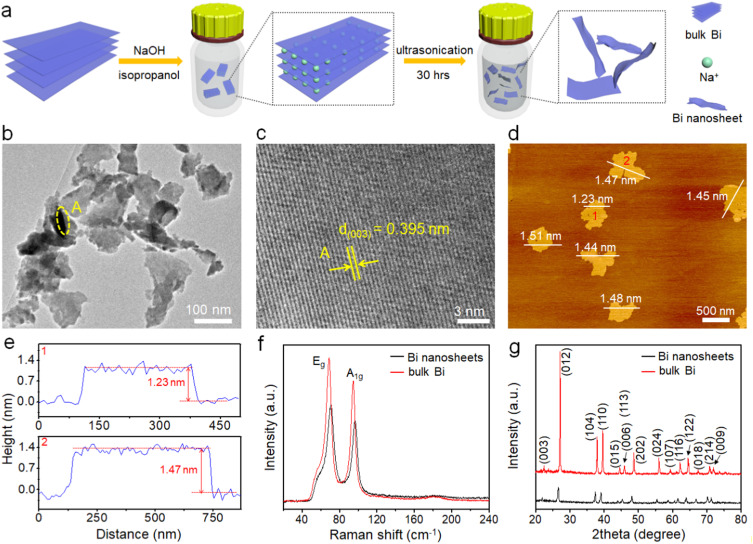
Pnictogen (As, Sb, Bi) Nanosheets for Electrochemical Applications Are Produced by Shear Exfoliation Using Kitchen Blenders

Layered materials are of high importance because of their anisotropy and as a source of 2D materials. Whilst there is a plethora of multi-elemental 2D materials, the number mono-elemental 2D materials is rather limited. Herein, we demonstrate that aqueous shear exfoliation can be used to obtain As, Sb, and Bi exfoliated nanosheets. Morphological and chemical …

Pnictogen (As, Sb, Bi) Nanosheets for Electrochemical Applications Are Produced by Shear Exfoliation Using Kitchen Blenders Read More »