SoK: Hospital at Home Model of Care – Toward Appropriate Use Cases and Other Challenges

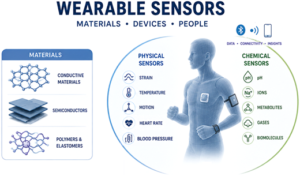
Analytical tools may revolutionize healthcare by enabling accessible, rapid, and decentralized testing. Wearable (bio)sensors, in particular, provide frequent or continuous patient monitoring through non- to minimally invasive measurements. This approach yields unprecedented amounts of health-related information, leading to more informed clinical decision-making and closer patient follow-up. In this mega-review article, we bring together leading researchers in the field to discuss the state of the art in wearable devices for health monitoring. We begin by providing a broad overview of the field through citation network analysis. We then review the application of chemical (bio)sensors in biofluids (e.g., sweat, saliva, tears, interstitial fluid, and cerebrospinal fluid), highlighting the challenges and advantages associated with each. Subsequently, we discuss the construction of wearable devices and their main formats (e.g., smart contact lenses, textiles, mouthguards, watches/wristbands, and implantable systems). Physical sensors are addressed in a dedicated section focusing on the assessment of heart rate, blood pressure, and body temperature. The role of soft electronics in wearable devices is also examined, as these technologies are essential for enhancing user comfort and sensor reliability, which demands advances in materials science. Furthermore, we present strategies for signal acquisition and transmission, as well as approaches for on-body energy harvesting and device self-powering. The use of artificial intelligence and machine learning is then discussed as a means of enhancing analytical performance and managing the large volumes of data generated by wearable devices. Finally, business, regulatory, and ethical considerations are examined. We expect that this review will provide an overview of sensing and biosensing technologies for health-related applications, identify promising research directions, and inspire future developments.
SoK: Hospital at Home Model of Care – Toward Appropriate Use Cases and Other Challenges

Printing technologies for monitoring crop health

Anode Free Zinc-Metal Batteries (AFZMBs): A New Paradigm in Energy Storage