Keyword Author: hydrogen evolution

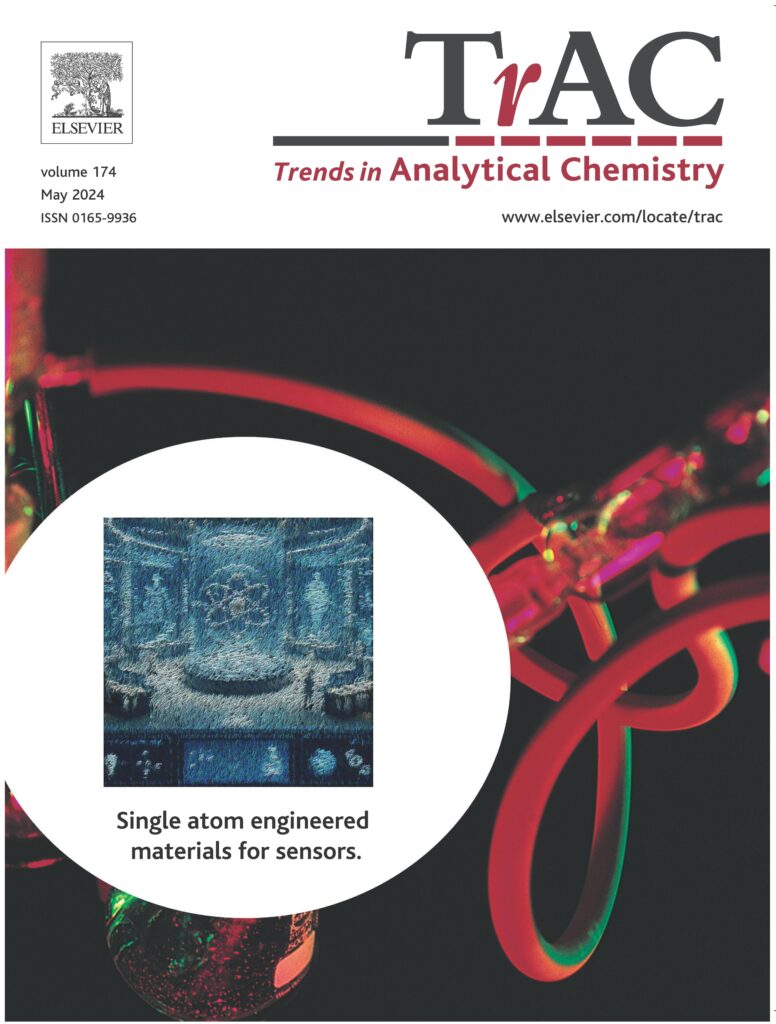
Single atom engineered materials for sensors

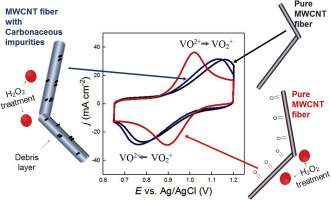
The pursuit of high-performance sensors necessitates the exploration of new materials to realize this potential. Single atom engineering (SAE) is used to plant individual atoms into the appropriate surrounding of (nano)materials in order to confer distinct materials properties. Hence, the nano architectonics principle utilized for single atom engineering allows us to build highly specific, selective, …
Single atom engineered materials for sensors Read More »

Two-Dimensional Materials on the Rocks: Positive and Negative Role of Dopants and Impurities in Electrochemistry

Two-dimensional (2D) materials, such as graphene and transition-metal chalcogenides, were shown in many works as very potent catalysts for industrially important electrochemical reactions, such as oxygen reduction, hydrogen and oxygen evolution, and carbon dioxide reduction. We critically discuss here the development in the field, showing that not only dopants but also impurities can have dramatic …

Two-Dimensional Materials on the Rocks: Positive and Negative Role of Dopants and Impurities in Electrochemistry Read More »

Tunable Pt-MoSx Hybrid Catalysts for Hydrogen Evolution

Platinum (Pt)-based materials are inevitably among the best-performing electrocatalysts for hydrogen evolution reaction (HER). MoS2 was suggested to be a potent HER catalyst to replace Pt in this reaction by theoretical modeling; however, in practice, this dream remains elusive. Here we show a facile one-pot bottom-up synthesis of Pt-MoSx composites using electrochemical reduction in an …

Tunable Pt-MoSx Hybrid Catalysts for Hydrogen Evolution Read More »

Morphological Effects and Stabilization of the Metallic 1T Phase in Layered V-, Nb-, and Ta-Doped WSe2 for Electrocatalysis

Layered transition-metal dichalcogenides ( TMDs) are valued for their electrocatalytic properties toward the hydrogen-evolution reaction ( HER) and oxygen-reduction reaction ( ORR). One effective strategy to activate the electrocatalytic properties of TMDs is through doping. The optimistic outlook of doped-MoS2 as an electrocatalyst witnessed in previous reports spurred us to examine the effect of doping …

Morphological Effects and Stabilization of the Metallic 1T Phase in Layered V-, Nb-, and Ta-Doped WSe2 for Electrocatalysis Read More »

Inverse Opal-like Porous MoSeX Films for Hydrogen Evolution Catalysis: Overpotential-Pore Size Dependence

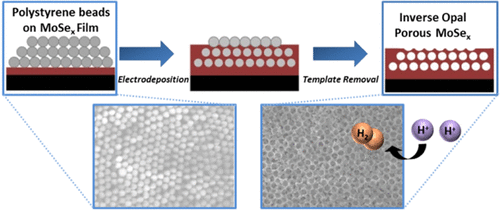
Transition metal dichalcogenides (TMDs) are prized as electrocatalysts for hydrogen evolution reaction (HER). Common TMD syntheses entail conditions of high temperatures and reagents that are detrimental to the environment. The electrochemical synthesis of TMDs is advocated as a viable alternative to the conventional synthetic procedures in terms of simplicity, ecological sustainability, and versatility of deposition …

Inverse Opal-like Porous MoSeX Films for Hydrogen Evolution Catalysis: Overpotential-Pore Size Dependence Read More »

Layered Transition-Metal Ditellurides in Electrocatalytic Applications-Contrasting Properties

The layered compounds and especially transition-metal dichalcogenides are at the forefront of current research on electrocatalytic materials. Despite the fact that electrocatalytical properties of molybdenum and tungsten disulfides are well-known, their tellurium analogues are significantly less explored. Here we show an effective method for MoTe2 and WTe2 chemical exfoliation based on alkali metal intercalation and …

Layered Transition-Metal Ditellurides in Electrocatalytic Applications-Contrasting Properties Read More »

Unconventionally Layered CoTe2 and NiTe2 as Electrocatalysts for Hydrogen Evolution

Two members of the transition metal ditelluride family, CoTe2 and NiTe2, exist in multiple structures encompassing marcasite-, pyrite- and CdI2 related structures. The allotrope modification is influenced by weak changes in stoichiometry and synthesis. It is crucial to emphasize that the CdI2 structure type is manifested by NiTe2 while the CoTe2 adopts a related structure …

Unconventionally Layered CoTe2 and NiTe2 as Electrocatalysts for Hydrogen Evolution Read More »

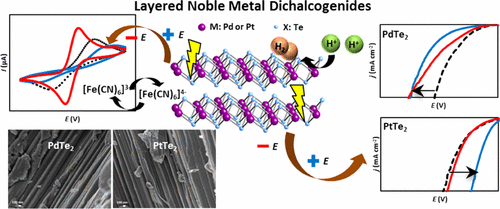
Layered Noble Metal Dichalcogenides: Tailoring Electrochemical and Catalytic Properties

Owing to the anisotropic nature, layered transition metal dichalcogenides (TMDs) have captured tremendous attention for their promising uses in a plethora of applications. Currently, bulk of the research is centered on Group 6 TMDs. Layered noble metal dichalcogenides, in particular the noble metal tellurides, belong to a subset of Group 10 TMDs, wherein the transition …

Layered Noble Metal Dichalcogenides: Tailoring Electrochemical and Catalytic Properties Read More »

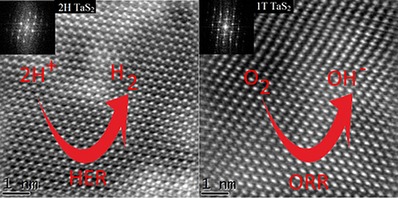
2H -> 1T Phase Engineering of Layered Tantalum Disulfides in Electrocatalysis: Oxygen Reduction Reaction

Tremendous attention is currently being paid to renewable sources of energy. Transition-metal dichalcogenides (TMDs) have been intensively studied for their promising catalytic activities in the hydrogen evolution reaction (HER) and the oxygen reduction reaction (ORR). In this fundamental work, we explored the catalytic properties of TMD family members 2HTaS(2) and 1T TaS2. Our findings reveal …

2H -> 1T Phase Engineering of Layered Tantalum Disulfides in Electrocatalysis: Oxygen Reduction Reaction Read More »

Aromatic-Exfoliated Transition Metal Dichalcogenides: Implications for Inherent Electrochemistry and Hydrogen Evolution

In the face of rising energy demand and depleting energy resources, energy sustainability has proven to be a formidable environmental and economic challenge, and the search for environmentally friendly energy sources is exigent. To this end, much research has been focused on improving the efficiency of the hydrogen evolution reaction (HER), which generates hydrogen gas, …

Aromatic-Exfoliated Transition Metal Dichalcogenides: Implications for Inherent Electrochemistry and Hydrogen Evolution Read More »

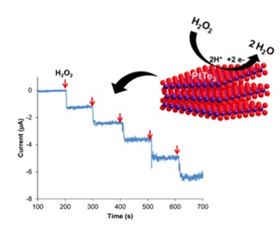
Layered Platinum Dichalcogenides (PtS2, PtSe2, and PtTe2) Electrocatalysis: Monotonic Dependence on the Chalcogen Size

Presently, research in layered transition metal dichalcogenides (TMDs) for numerous electrochemical applications have largely focused on Group 6 TMDs, especially MoS2 and WS2, whereas TMDs belonging to other groups are relatively unexplored. This work unravels the electrochemistry of Group 10 TMDs: specifically PtS2, PtSe2, and PtTe2. Here, the inherent electroactivities of these Pt dichalcogenides and …

Layered Platinum Dichalcogenides (PtS2, PtSe2, and PtTe2) Electrocatalysis: Monotonic Dependence on the Chalcogen Size Read More »

Bottom-up Electrosynthesis of Highly Active Tungsten Sulfide (WS3-x) Films for Hydrogen Evolution

Transition metal dichalcogenides have been I extensively studied as promising earth-abundant electrocatalysts for hydrogen evolution reaction (HER). However, despite the intention to achieve sustainable energy generation, conventional syntheses typically use environmentally damaging reagents and energy-demanding preparation conditions. Hence, we present electrochemical synthesis as a green and versatile alternative to traditional methods. In this fundamental study, …

Bottom-up Electrosynthesis of Highly Active Tungsten Sulfide (WS3-x) Films for Hydrogen Evolution Read More »

Anti-MoS2 Nanostructures: Tl2S and Its Electrochemical and Electronic Properties

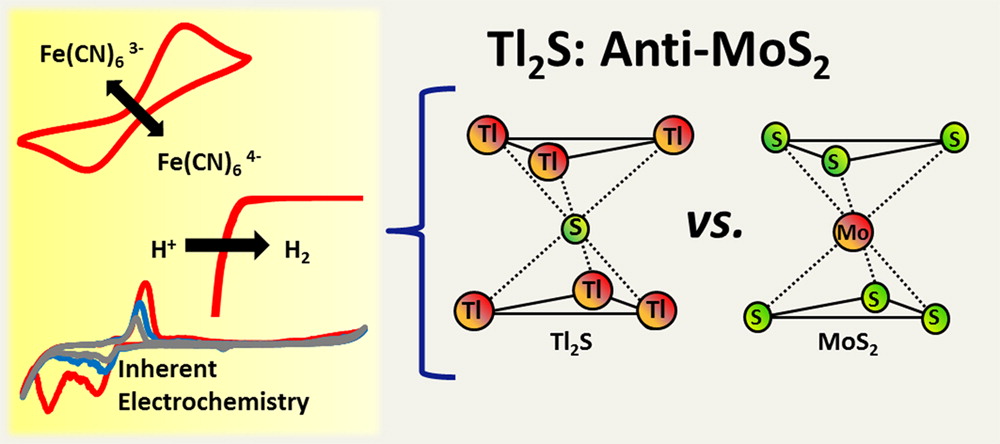
Layered transition metal dichalcogenides are catalytically important compounds. Unlike the mounting interest in transition metal dichalcogenides such as MoS2 and WS2 for electrochemical applications, other metal chalcogenides with layered structure but different chemical composition have received little attention among the scientific community. One such example is represented by thallium(I) sulfide (Tl2S), a Group 13 chalcogenide, …

Anti-MoS2 Nanostructures: Tl2S and Its Electrochemical and Electronic Properties Read More »

Impact Electrochemistry of Layered Transition Metal Dichalcogenides

Layered transition metal dichalcogenides (TMDs) exhibit paramount importance in the electrocatalysis of the hydrogen evolution reaction. It is crucial to determine the size of the electrocatalytic particles as well as to establish their electrocatalytic activity, which occurs at the edges of these particles. Here, we show that individual TMD (MoS2, MoSe2, WS2, or WSe2; in …

Impact Electrochemistry of Layered Transition Metal Dichalcogenides Read More »

Catalytic and Charge Transfer Properties of Transition Metal Dichalcogenides Arising from Electrochemical Pretreatment

Layered transition metal dichalcogenides (TMDs) have been the center of attention in the scientific community due to their properties that can be tapped on for applications in electrochemistry and hydrogen evolution reaction (HER) catalysis. We report on the effect of electrochemical treatment of exfoliated MoS2, WS2, MoSe2 and WSe2 nanosheets toward the goal of activating …

Catalytic and Charge Transfer Properties of Transition Metal Dichalcogenides Arising from Electrochemical Pretreatment Read More »