Keyword Author: exfoliation

Exfoliated Layered Manganese Trichalcogenide Phosphite (MnPX3, X = S, Se) as Electrocatalytic van der Waals Materials for Hydrogen Evolution

Layered metal trichalcogen phosphites, also entitled as metal phosphorus chalcogenides (MPX3), have regained abundant interest, not only due to their magnetic properties, but also due to promising performances in energy storage and conversion. Herein, two different layered manganese trichalcogen phosphites, MnPX3 (X = S, Se), are synthetized and submitted to shear force exfoliation. Structural and …
Exfoliated Layered Manganese Trichalcogenide Phosphite (MnPX3, X = S, Se) as Electrocatalytic van der Waals Materials for Hydrogen Evolution Read More »

Electrochemical Exfoliation of MoS2 Crystal for Hydrogen Electrogeneration

Transition metal dichalcogenides (TMDs) have recently emerged within the group of 2D materials due to their electrical, catalytic and optical properties significantly enhanced and useful when down-sized to single layer. In particular, MoS2 has attracted much attention due to its semiconducting nature with a useful band gap when present as single layer, the enhanced photoluminescence, …

Electrochemical Exfoliation of MoS2 Crystal for Hydrogen Electrogeneration Read More »

Functional Protection of Exfoliated Black Phosphorus by Noncovalent Modification with Anthraquinone

Few and monolayer black phosphorus (phosphorene) is currently an intensively researched material. Shear exfoliated black phosphorus (BPSE) nano sheets were functionalized with the redox active antraquinone (AQ) that can provide additional charge storage capacity. The noncovalent interaction of BP with AQ occurs due to van der Waals interactions. X-ray photoelectron spectroscopy results show that AQ …

Functional Protection of Exfoliated Black Phosphorus by Noncovalent Modification with Anthraquinone Read More »

Layered Transition-Metal Ditellurides in Electrocatalytic Applications-Contrasting Properties

The layered compounds and especially transition-metal dichalcogenides are at the forefront of current research on electrocatalytic materials. Despite the fact that electrocatalytical properties of molybdenum and tungsten disulfides are well-known, their tellurium analogues are significantly less explored. Here we show an effective method for MoTe2 and WTe2 chemical exfoliation based on alkali metal intercalation and …

Layered Transition-Metal Ditellurides in Electrocatalytic Applications-Contrasting Properties Read More »

Electrochemical Exfoliation of Layered Black Phosphorus into Phosphorene

Among 2D materials that recently have attracted enormous interest, black phosphorus (BP) is gaining a rising popularity due to its tunable band-gap structure, which is strongly correlated to the thickness and can enable its use in optoelectronic and electronic applications. It is therefore important to provide a facile and scalable methodology to prepare single or …

Electrochemical Exfoliation of Layered Black Phosphorus into Phosphorene Read More »

Exfoliation of Layered Topological Insulators Bi2Se3 and Bi2Te3 via Electrochemistry

Among layered materials, topological insulators such as Bi2Se3 and Bi2Te3 are lately attracting much attention due to particular electronic properties and, especially with Bi2Te3, excellent thermoelectric properties. Methods of preparation of few-layered nanosheets of Bi2Se3 and Bi2Te3 range from the bottom-up chemical vapor deposition or hydrothermal synthesis from oxide precursors to the top-down mechanical exfoliation …

Exfoliation of Layered Topological Insulators Bi2Se3 and Bi2Te3 via Electrochemistry Read More »

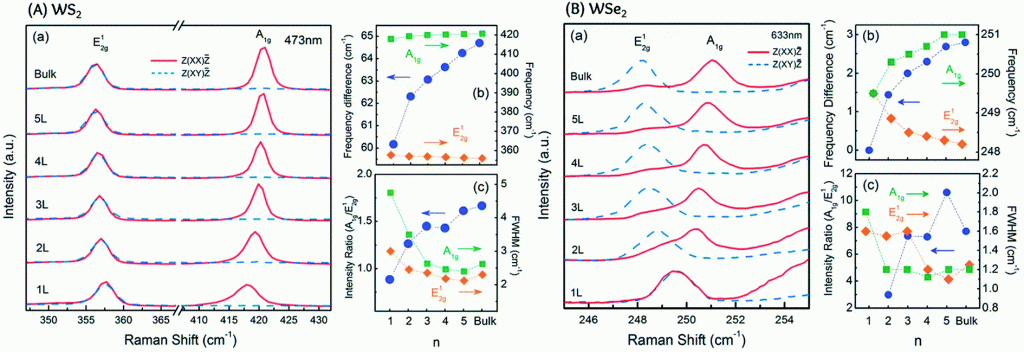
Transition metal dichalcogenides (MoS2, MoSe2, WS2 and WSe2) exfoliation technique has strong influence upon their capacitance

Transition metal dichacogenides (TMD) represent an important class of layered compounds which are gaining lately an enormous interest in electrochemistry. Exfoliation of TMD materials to obtain single to few layer sheets is generally obtained through the intercalation of organolithium compounds. Here we investigated and compared the capacitive behavior of four representative TMD materials, i.e. MoS2, …

Transition metal dichalcogenides (MoS2, MoSe2, WS2 and WSe2) exfoliation technique has strong influence upon their capacitance Read More »

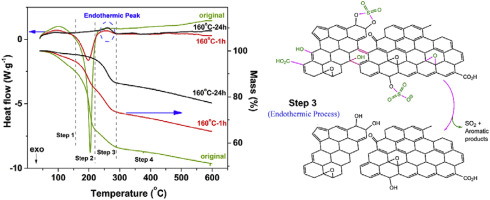
Insight into the Mechanism of the Thermal Reduction of Graphite Oxide: Deuterium-Labeled Graphite Oxide Is the Key

For the past decade, researchers have been trying to understand the mechanism of the thermal reduction of graphite oxide. Because deuterium is widely used as a marker in various organic reactions, we wondered if deuterium-labeled graphite oxide could be the key to fully understand this mechanism. Graphite oxides were prepared by the Hofmann, Hummers, Staudenmaier, …

Insight into the Mechanism of the Thermal Reduction of Graphite Oxide: Deuterium-Labeled Graphite Oxide Is the Key Read More »

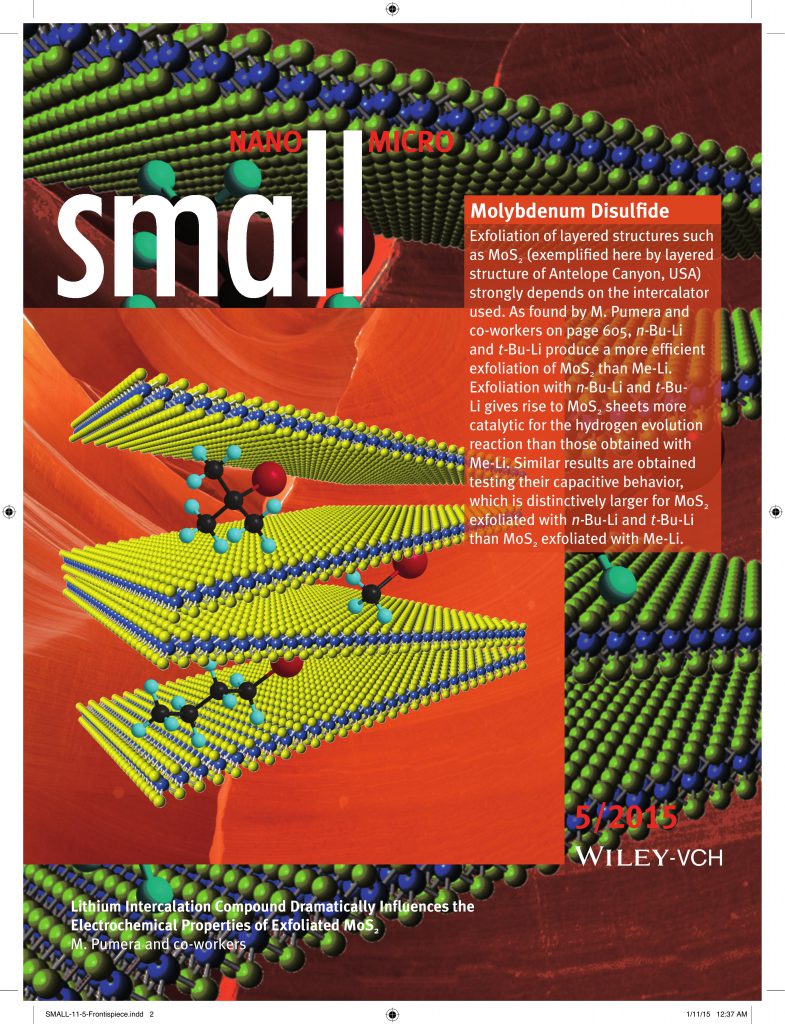
Lithium Intercalation Compound Dramatically Influences the Electrochemical Properties of Exfoliated MoS2

MoS2 and other transition metal dichalcogenides (TMDs) have recently gained a renewed interest due to the interesting electronic, catalytic, and mechanical properties which they possess when down-sized to single or few layer sheets. Exfoliation of the bulk multilayer structure can be achieved by a preliminary chemical Li intercalation followed by the exfoliation due to the …

Lithium Intercalation Compound Dramatically Influences the Electrochemical Properties of Exfoliated MoS2 Read More »

Exfoliated transition metal dichalcogenides (MoS2, MoSe2, WS2, WSe2): An electrochemical impedance spectroscopic investigation

Owing to the enthralling properties which transition metal dichalcogenides present, they are facing immense scientific interest from researchers. Till date, these two-dimensional materials have been assessed for a wide array of different applications and there are various synthetic methods of attaining them in their respective bulk and exfoliated forms. Herein, we explore the effects of …

Exfoliated transition metal dichalcogenides (MoS2, MoSe2, WS2, WSe2): An electrochemical impedance spectroscopic investigation Read More »

Carcinogenic Organic Residual Compounds Readsorbed on Thermally Reduced Graphene Materials are Released at Low Temperature

The preliminary oxidation of graphite to graphite oxide followed by a thermal exfoliation is one of the methods most frequently employed in the preparation of graphene. Such thermally reduced graphene can be widely used for several applications that range from coatings to sensing device fabrication. It is therefore important to investigate in detail the fabrication …

Carcinogenic Organic Residual Compounds Readsorbed on Thermally Reduced Graphene Materials are Released at Low Temperature Read More »