Keyword Author: cyclic voltammetry

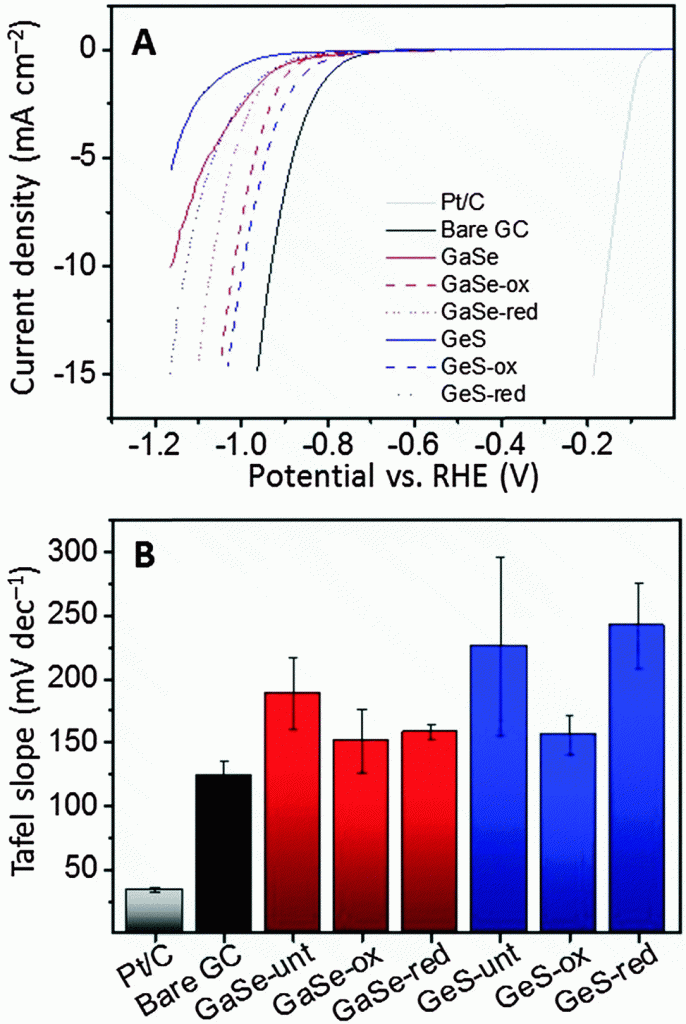
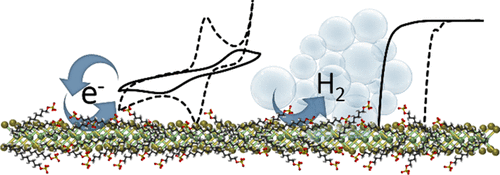
MoSe2 Dispersed in Stabilizing Surfactant Media: Effect of the Surfactant Type and Concentration on Electron Transfer and Catalytic Properties

Layered transition metal dichalcogenides (TMDs) have gained attention from the scientific community because of their extended range of applications. Molybdenum diselenide (MoSe2) has been proven to be an efficient catalyst for the hydrogen evolution reaction (HER), having implications in the research of new catalysts for clean energy production. One way to produce large quantities of …
MoSe2 Dispersed in Stabilizing Surfactant Media: Effect of the Surfactant Type and Concentration on Electron Transfer and Catalytic Properties Read More »

Intrinsic electrochemical performance and precise control of surface porosity of graphene-modified electrodes using the drop-casting technique

Graphenes have for a long time been shown to exhibit enhanced electrochemical sensing and fast heterogeneous electron transfers, but the nature of such improved electrochemistry is disputed due to its inherent porosity. Adsorption and thin layer effects may additionally contribute to the observed behaviour. Furthermore, overall extents of the impact from these factors are typically …

Intrinsic electrochemical performance and precise control of surface porosity of graphene-modified electrodes using the drop-casting technique Read More »

Direct Voltammetric Determination of Redox-Active Iron in Carbon Nanotubes

With the advances in nanotechnology over the past decade, consumer products are increasingly being incorporated with carbon nanotubes (CNTs). As the harmful effects of CNTs are suggested to be primarily due to the bioavailable amounts of metallic impurities, it is vital to detect and quantify these species using sensitive and facile methods. Therefore, in this …

Direct Voltammetric Determination of Redox-Active Iron in Carbon Nanotubes Read More »

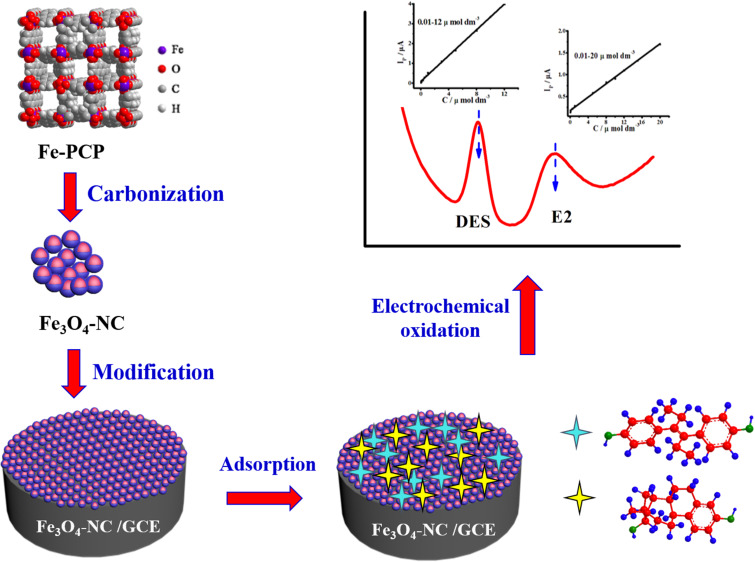
Mycotoxins: Simultaneous Detection of Zearalenone and Citrinin by Voltammetry on Edge Plane Pyrolytic Graphite Electrode

Mycotoxins are highly toxic compounds often found in the food. It is of paramount importance to have analytical technique for point-of-care on-spot detection for authorised personnel to immediately take the action required. Electrochemistry offers the portability for miniaturized sensor of mycotoxins. Here we show that edge-plane pyrolytic electrode offers excellent selectivity and sensitivity towards simultaneous …

Mycotoxins: Simultaneous Detection of Zearalenone and Citrinin by Voltammetry on Edge Plane Pyrolytic Graphite Electrode Read More »

Unusual Inherent Electrochemistry of Graphene Oxides Prepared Using Permanganate Oxidants

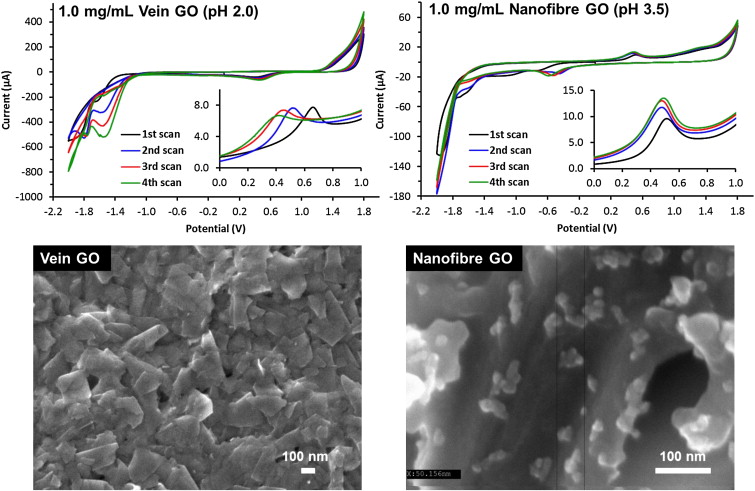
Graphene and graphene oxides are materials of significant interest in electrochemical devices such as supercapacitors, batteries, fuel cells, and sensors. Graphene oxides and reduced graphenes are typically prepared by oxidizing graphite in strong mineral acid mixtures with chlorate (Staudenmaier, Hofmann) or permanganate (Hummers, Tour) oxidants. Herein, we reveal that graphene oxides pose inherent electrochemistry, that …

Unusual Inherent Electrochemistry of Graphene Oxides Prepared Using Permanganate Oxidants Read More »

Graphane electrochemistry: Electron transfer at hydrogenated graphenes

Graphane, the hydrogenated derivate of graphene is a highly novel material in the field of two dimensional nanocarbon related research. Preparation of hydrogenated graphene is achieved via a high-pressure/high-temperature (up to 150 bar and 500 degrees C) thermal exfoliation procedure of graphite oxide. We investigated the properties of the materials via voltammetry and electrochemical impedance …

Graphane electrochemistry: Electron transfer at hydrogenated graphenes Read More »

Bioavailability of Metallic Impurities in Carbon Nanotubes Is Greatly Enhanced by Ultrasonication

Metallic impurities within carbon nanotubes (CNTs) are considered as the main cause of their toxicity. Ultrasonication is a common procedure used to purify and obtain homogeneous dispersions of CNTs as well as to mix them with other components for further processing into composites. Herein, the influence of ultrasonication upon the bioavailability of metallic impurities in …

Bioavailability of Metallic Impurities in Carbon Nanotubes Is Greatly Enhanced by Ultrasonication Read More »

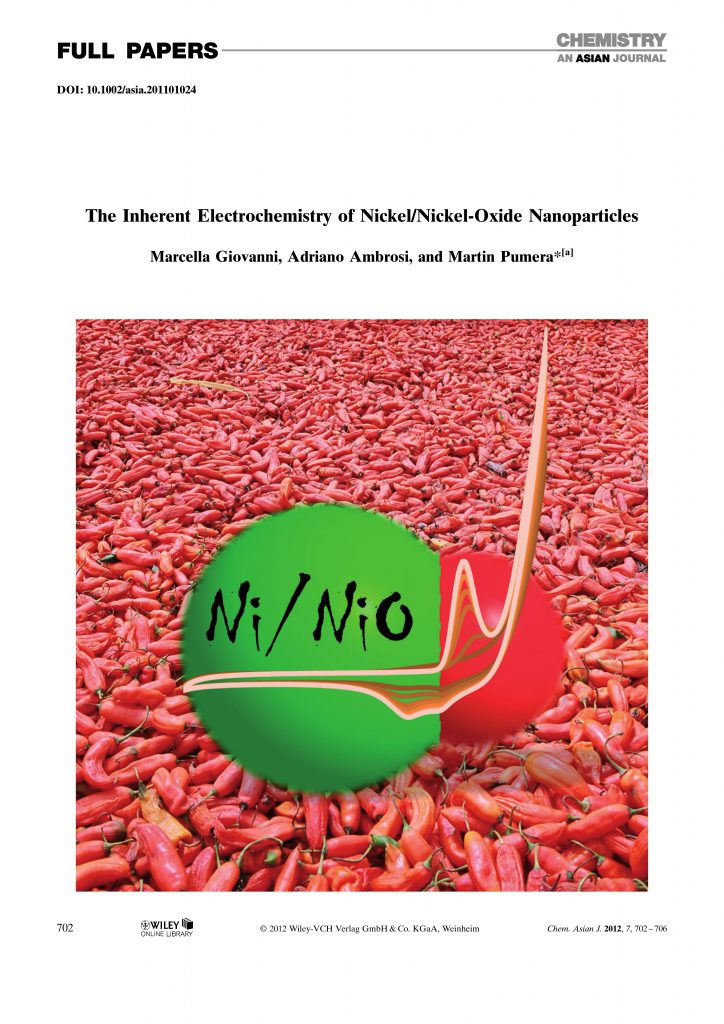
The Inherent Electrochemistry of Nickel/Nickel-Oxide Nanoparticles

The direct detection of nanoparticles is at the forefront of research owing to their environmental and toxicological applications. Herein, we studied the inherent electrochemistry of Ni and NiO nanoparticles and proposed a simple and direct electrochemical method for the determination of the concentrations of both nickel (Ni) and nickel oxide (NiO) nanoparticles in alkaline solution. …

The Inherent Electrochemistry of Nickel/Nickel-Oxide Nanoparticles Read More »

Nanoporous Carbon Materials for Electrochemical Sensing

Nanoporous carbon materials are highly important materials for a wide array of applications. Here we show that nanoporous carbon can act as highly active materials for electrochemical sensing. We observed that nanoporous carbon material exhibits a faster heterogeneous electron transfer than graphite and pure carbon nanotubes. Nanoporous carbon exhibits a superior electrochemical performance for sensing …

Nanoporous Carbon Materials for Electrochemical Sensing Read More »

Electrochemical properties of double wall carbon nanotube electrodes

Electrochemical properties of double wall carbon nanotubes (DWNT) were assessed and compared to their single wall (SWNT) counterparts. The double and single wall carbon nanotube materials were characterized by Raman spectroscopy, scanning and transmission electron microscopy and electrochemistry. The electrochemical behavior of DWNT film electrodes was characterized by using cyclic voltammetry of ferricyanide and NADH. …

Electrochemical properties of double wall carbon nanotube electrodes Read More »