Single-Atom Engineering in Room-Temperature Sodium–Sulfur Batteries

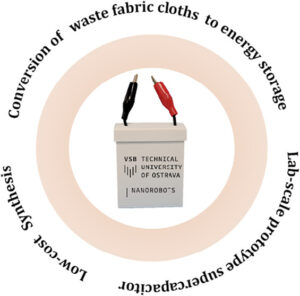
Waste fashion fabric cloth materials, including such household items as wet wipes, diapers, masks, disposable gloves, discarded bedsheets, washing cloths, pillow covers, etc., pose an important environmental problem as they are generally nonrecyclable and ultimately accumulate in landfills, liberating poisonous byproducts into the environment. With growing energy concerns, cost-effective, lightweight, and durable energy storage devices are needed to provide a continuous and reliable energy supply. Herein, we develop supercapacitor electrodes using waste fashion fabric material. This includes a straightforward process that utilizes both negative and positive electrodes, i.e., bismuth oxide (Bi2O3) and cobalt metal–organic frameworks (Co–MOFs), spread over fabric cloths using a room temperature synthesis method. Here, we propose a highly extendable “power bank” pouch-type nanoarchitectonics principle guided supercapacitor device, Co–MOF//Bi2O3, which offers excellent electrochemical energy storage for portable electronics devices. This work presents a simple and room-temperature synthetic strategy for transforming waste fashion fabric cloth into excellent supercapacitor electrodes for a real-world prototype supercapacitor device. Therefore, this study provides an environmentally friendly, economically viable, and high-performance waste fashion fabric cloth supercapacitor electrode material for powering portable electronic devices.
Single-Atom Engineering in Room-Temperature Sodium–Sulfur Batteries

Recyclable HF-free Ti3C2Tx 3D-printed supercapacitors: their second life in sodium-ion batteries

Aqueous Multivalent Metal-ion Batteries: Toward 3D-printed Architectures