Single-Atom Engineering in Room-Temperature Sodium–Sulfur Batteries

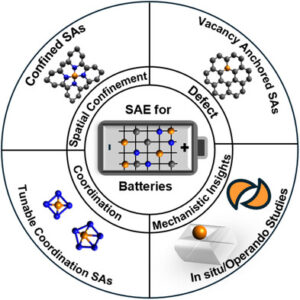
Single-atom engineering (SAE) is a promising approach for next-generation rechargeable batteries due to its maximal atom utilization, high catalytic activity, and tunable selectivity. However, the incomplete understanding of the microenvironment of single atoms and their electrochemical behavior limits their practical application in rechargeable batteries. Most existing review articles either discuss battery chemistry or characterization techniques and rarely connect atomic-scale defects, confinement, and coordination design to practical battery performance and its operando mechanism. This article provides an overview of SAE and examines both carbon- and metal-based hosts, focusing on how microenvironment engineering influences electronic structure, charge transfer, active-site stability, and energy efficiency. The major synthetic routes for constructing isolated and densely packed single-atom sites are compared, and their advantages, limitations, and scalability are evaluated. Finally, it discusses applications of SAE in metal, metal-ion, metal-sulfur, and metal-air batteries with an emphasis on metal nucleation, polysulfide/oxygen redox kinetics, and long-term cycling, and integrates advanced ex situ and in situ/operando characterization with theoretical and data-driven studies to clarify the dynamic structure–function relationships of single-atom sites under battery cycling. Together, these perspectives provide a clear framework for designing robust, scalable next-generation batteries based on SAE.
Single-Atom Engineering in Room-Temperature Sodium–Sulfur Batteries

Periodic Table Exploration of MXenes for Efficient Electrochemical Nitrate Reduction to Ammonia

Engineering 3D Printed Structures Towards Electrochemically Driven Green Ammonia Synthesis: A Perspective