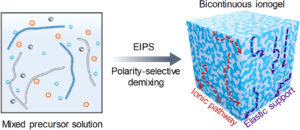
The widespread adoption of stretchable ionogels for emerging soft iontronics has been impeded by an inherent trade-off between mechanical robustness and ionic conductivity. Moreover, most existing approaches rely on intricate molecular designs or multistep processing, posing significant challenges to scalability and processability. Herein, we develop a facile and generalizable solvent-evaporation-induced phase-separation strategy that yields ionogels with superior toughness and ionic conductivity. By rationally pairing the ionophilic thermoplastic polyurethane (TPU) and ionophobic poly(styrene-ethylene/butylene-styrene) (SEBS), a bicontinuous phase-separated architecture spontaneously emerges, guided by their polarity selectivity in ionic components and solvents. In this architecture, the ionic species preferentially partition into TPU-rich phases, establishing noncovalently confined ion transport networks, while ionophobic SEBS-rich phases impart mechanical reinforcement and structural stability without compromising ionic conductivity. The well-designed ionogels exhibit high stretchability (over 1500%), tensile strength (12.8 MPa), toughness (86.1 MJ m–3), and ionic conductivity (1.97 × 10⁻² S m–1), as well as favorable elasticity and recyclability. Multimodal ionic skins fabricated with these tough and stretchable ionogels demonstrate sensitive and reliable responses to strain, pressure, and temperature stimuli, alongside the possibility to assemble wearable supercapacitors to power wireless gas-sensing devices. This fabrication strategy can be generalized to a variety of polymer-ionic systems, with potential applications in next-generation soft and wearable iontronic devices.