Printing technologies for monitoring crop health

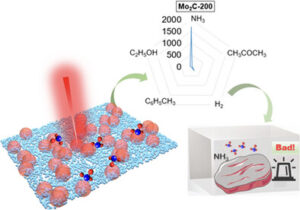
The need for advanced gas sensors has risen for the detection of hazardous gases, breath analysis, and food industry applications. Transition metal carbides (TMCs), like Mo2C, are novel gas-sensing materials attributed to high electronic conductivity and superior catalytic properties. Poor sensitivity and selectivity are big concerns in TMC-based sensors due to their low specific surface area and fewer reactive sites. Partial oxidation of Mo2C offers the tuning of structural, chemical, and electronic properties. However, conventional techniques, annealing, and solution processing offer uncontrolled oxidation and lead to structural degradation. Herein, by using a temporally and spatially controlled picosecond (ps) pulsed laser, micropatterned Mo2C-derived oxide (MoO3) is developed at room temperature for highly efficient ammonia (NH3) sensing. The uniformly decorated MoO3 nanoclusters over Mo2C function as active centers for better NH3 interaction and formation of discrete Schottky barriers (SBs) between materials, tuning the charge carrier transportation. The MoO3/Mo2C sensor exhibited excellent selectivity toward NH3 over other interfering gases like hydrogen, ethanol, and acetone. This sensor showed excellent sensitivity (351%/100 parts per billion (ppb) NH3) and long-term stability. The Mo2C laser-treated sensor has been successfully tested for monitoring food spoilage. Laser-assisted engineering will provide a new avenue for designing highly efficient gas sensors.
Printing technologies for monitoring crop health

Improving Ni(OH)2 electrocatalysis with graphene quantum dots

MXene-Based Nanocomposites for Supercapacitors: Fundamentals and Applications