Keyword Author: Supercapacitors

Laser induced MXene-derived oxide based advanced supercapacitor for wireless applications

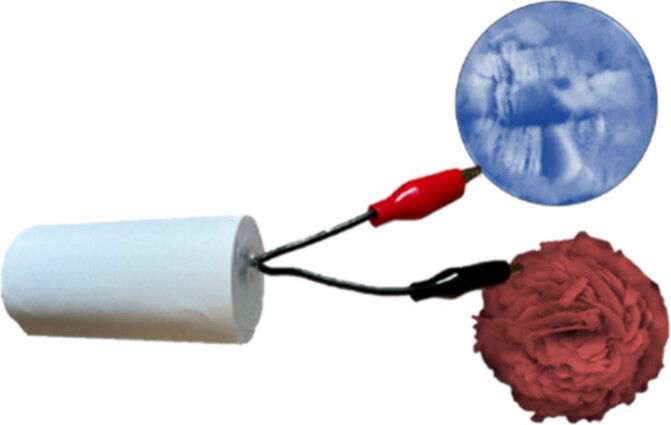
The development of energy storage systems for wireless and wearable electronics requires electrode materials that combine high energy density, mechanical flexibility, and long-term cycling stability. Here, we present a laser-engineering strategy for Ti3C2Tx MXene electrodes that induces surface oxidation and forms a hybrid structure comprising in-situ grown TiO2 nanostructures embedded on a conductive MXene matrix. …
Laser induced MXene-derived oxide based advanced supercapacitor for wireless applications Read More »

Recyclable HF-free Ti3C2Tx 3D-printed supercapacitors: their second life in sodium-ion batteries

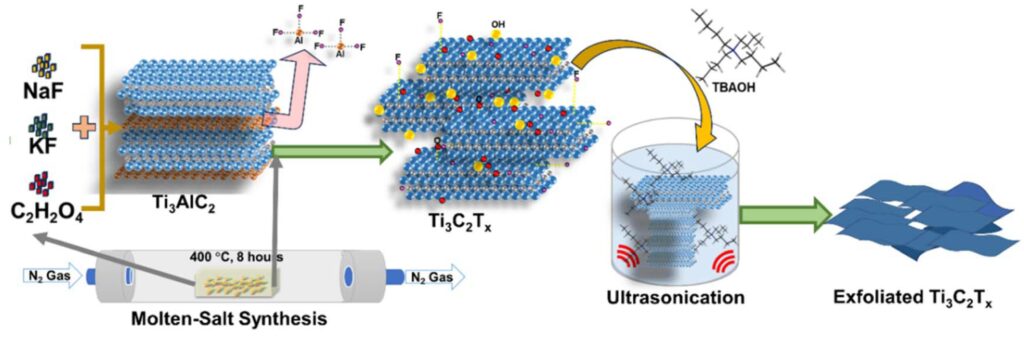
2D MXenes represent a useful class of materials in various applications and the main constraint for their bulk production is the requirement of hazardous hydrogen fluoride (HF) as an etching agent. Molten salt synthesis is one of the emerging HF-free techniques to produce MXenes, where a mixture of etching salts is heated till their melting …

Recyclable HF-free Ti3C2Tx 3D-printed supercapacitors: their second life in sodium-ion batteries Read More »

High Performance MXene/MnCo2O4 Supercapacitor Device for Powering Small Robotics

The development of advanced energy storage devices is critical for various applications including robotics and portable electronics. The energy storage field faces significant challenges in designing devices that can operate effectively for extended periods while maintaining exceptional electrochemical performance. Supercapacitors, which bridge the gap between batteries and conventional capacitors, offer a promising solution due to …

High Performance MXene/MnCo2O4 Supercapacitor Device for Powering Small Robotics Read More »

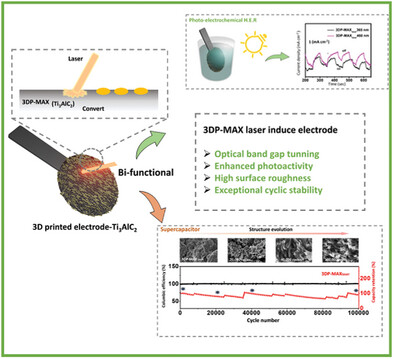
Nanoarchitectonics of Laser Induced MAX 3D-Printed Electrode for Photo-Electrocatalysis and Energy Storage Application with Long Cyclic Durability of 100 000 Cycles

3D printing, a rapidly expanding domain of additive manufacturing, enables the fabrication of intricate 3D structures with adjustable fabrication parameters and scalability. Nonetheless, post-fabrication, 3D-printed materials often require an activation step to eliminate non-conductive polymers, a process traditionally achieved through chemical, thermal, or electrochemical methods. These conventional activation techniques, however, suffer from inefficiency and inconsistent …

Nanoarchitectonics of Laser Induced MAX 3D-Printed Electrode for Photo-Electrocatalysis and Energy Storage Application with Long Cyclic Durability of 100 000 Cycles Read More »

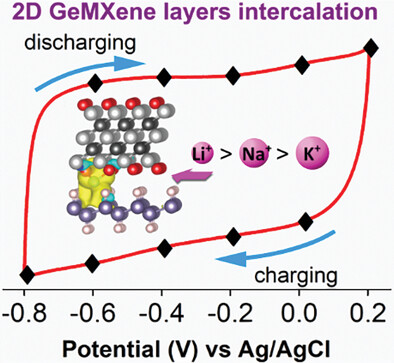
2D Germanane-MXene Heterostructures for Cations Intercalation in Energy Storage Applications

Heterostructures offer an exceptional possibility of combining individual 2D materials into a new material having altered properties compared to the parent materials. Germanane (GeH) is a 2D material with many favorable properties for energy storage and catalysis, however, its performance is hindered by its low electrical conductivity. To address the low electrochemical performance of GeH, …

2D Germanane-MXene Heterostructures for Cations Intercalation in Energy Storage Applications Read More »

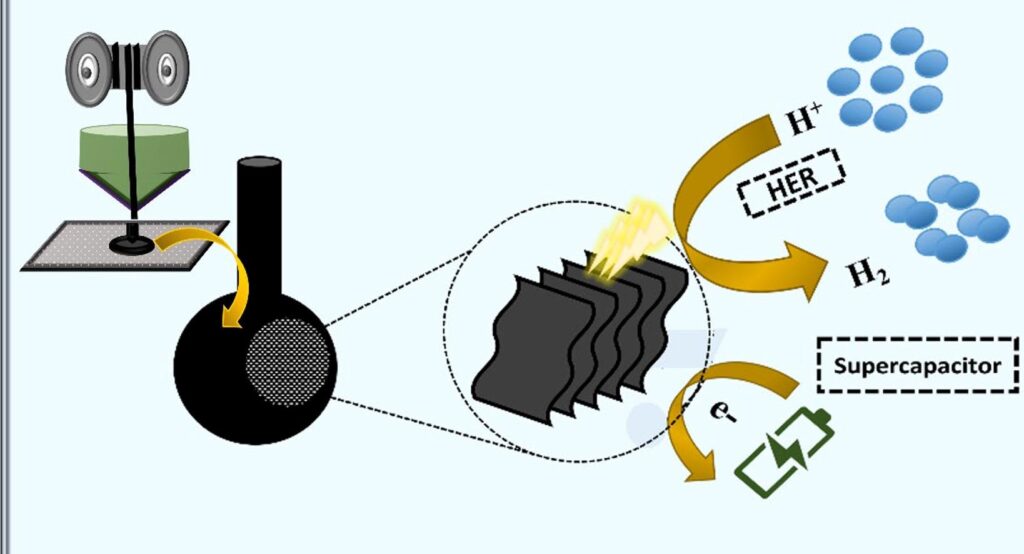
3D printing of MAX/PLA filament: Electrochemical in-situ etching for enhanced energy conversion and storage

Two-dimensional (2D) MXenes are promising materials for a variety of sustainable energy-related applications such as photoelectrochemical water splitting and energy storage devices. Among the MXene family, the Ti3C2Tx is mostly prepared by selective etching of Al from the Ti3AlC2 MAX phase using hydrofluoric acid (HF) or in-situ produced HF as an etchant. However, the severe …

3D printing of MAX/PLA filament: Electrochemical in-situ etching for enhanced energy conversion and storage Read More »

The capacitance and electron transfer of 3D-printed graphene electrodes are dramatically influenced by the type of solvent used for pre-treatment

3D-printing (or additive manufacturing) is presently an emerging technology that promises to reshape traditional manufacturing processes. The electrochemistry field can certainly take advantage of this fabrication tool for sensing and energy-related applications. Polymer/graphene filaments commonly used for the fabrication of 3D-printed electrodes show poor electrochemistry in the native state, requiring post-fabrication activation procedures. In the …

The capacitance and electron transfer of 3D-printed graphene electrodes are dramatically influenced by the type of solvent used for pre-treatment Read More »

Nanogold Spacing of Stacked Graphene Nanofibers for Supercapacitors

Graphene exhibits great potential for energy storage devices in electrochemical supercapacitors as it is a lightweight, inexpensive material. However, as graphene nanomaterials are prone to stacking and therefore blocking electroactive sites, its real capacity is low. Recently, there has been a significant interest in quasi 1D structures of carbon nanofibers with radially oriented graphene sheets, …

Nanogold Spacing of Stacked Graphene Nanofibers for Supercapacitors Read More »