Keyword Author: redox chemistry

Bioavailability of Metallic Impurities in Carbon Nanotubes Is Greatly Enhanced by Ultrasonication

Metallic impurities within carbon nanotubes (CNTs) are considered as the main cause of their toxicity. Ultrasonication is a common procedure used to purify and obtain homogeneous dispersions of CNTs as well as to mix them with other components for further processing into composites. Herein, the influence of ultrasonication upon the bioavailability of metallic impurities in …
Bioavailability of Metallic Impurities in Carbon Nanotubes Is Greatly Enhanced by Ultrasonication Read More »

Inherent Electrochemistry and Activation of Chemically Modified Graphenes for Electrochemical Applications

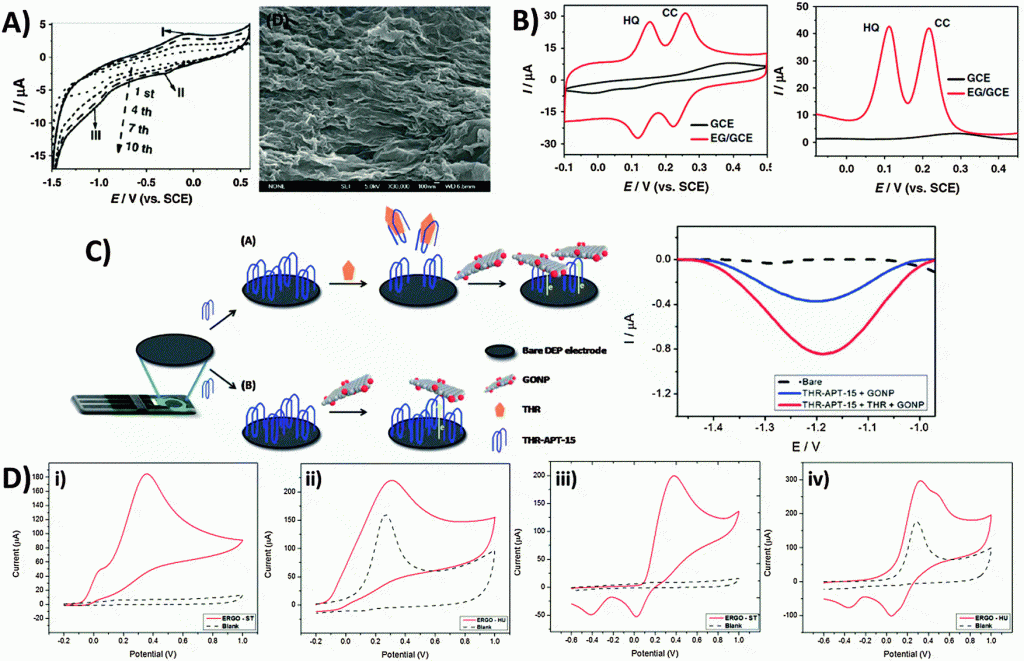
Graphene research is currently at the frontier of electrochemistry. Many different graphene-based materials are employed by electrochemists as electrodes in sensing and in energy-storage devices. Because the methods for their preparation are inherently different, graphene materials are expected to exhibit different electrochemical behaviors depending on the functionalities and density of defects present. Electrochemical treatment of …

Inherent Electrochemistry and Activation of Chemically Modified Graphenes for Electrochemical Applications Read More »

Redox-Active Nickel in Carbon Nanotubes and Its Direct Determination

The presence of residual metal-catalyst impurities in carbon nanotubes is responsible for their toxicity. It is important to differentiate between the total amount of impurities and the redox-active (bioavailable) amount of such impurities because only the bioavailable impurities exhibit toxic effects. Herein, we report a simple and specific method for quantifying the amount of redox-active …

Redox-Active Nickel in Carbon Nanotubes and Its Direct Determination Read More »

Regulatory Peptides Are Susceptible to Oxidation by Metallic Impurities within Carbon Nanotubes

In this article, we show that the redox properties of the regulatory peptide L-glutathione are affected by the presence of nickel oxide impurities within single-walled carbon nanotubes (SWCNTs). Glutathione is a powerful antioxidant that protects cells from oxidative stress by removing free radicals and peroxides. We show that the L-cysteine moiety in L-glutathione is responsible …

Regulatory Peptides Are Susceptible to Oxidation by Metallic Impurities within Carbon Nanotubes Read More »