Keyword Author: molybdenum diselenide

MoSe2 Dispersed in Stabilizing Surfactant Media: Effect of the Surfactant Type and Concentration on Electron Transfer and Catalytic Properties

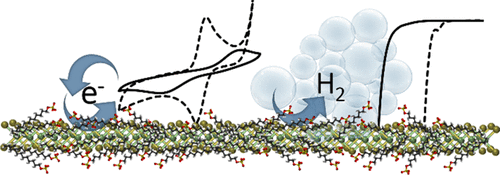
Layered transition metal dichalcogenides (TMDs) have gained attention from the scientific community because of their extended range of applications. Molybdenum diselenide (MoSe2) has been proven to be an efficient catalyst for the hydrogen evolution reaction (HER), having implications in the research of new catalysts for clean energy production. One way to produce large quantities of …
MoSe2 Dispersed in Stabilizing Surfactant Media: Effect of the Surfactant Type and Concentration on Electron Transfer and Catalytic Properties Read More »

Inverse Opal-like Porous MoSeX Films for Hydrogen Evolution Catalysis: Overpotential-Pore Size Dependence

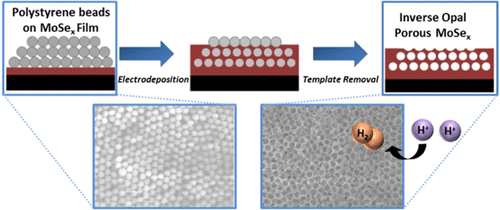
Transition metal dichalcogenides (TMDs) are prized as electrocatalysts for hydrogen evolution reaction (HER). Common TMD syntheses entail conditions of high temperatures and reagents that are detrimental to the environment. The electrochemical synthesis of TMDs is advocated as a viable alternative to the conventional synthetic procedures in terms of simplicity, ecological sustainability, and versatility of deposition …

Inverse Opal-like Porous MoSeX Films for Hydrogen Evolution Catalysis: Overpotential-Pore Size Dependence Read More »