Keyword Author: Fused deposition modelling

3D-Printed Nanocarbon Polymer Conductive Structures for Electromagnetic Interference Shielding

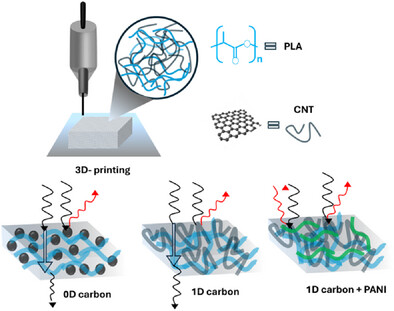
Electromagnetic interference (EMI) significantly affects the performance and reliability of electronic devices. Although current metallic shielding materials are effective, they have drawbacks such as high density, limited flexibility, and poor corrosion resistance that limit their wider application in modern electronics. This study investigates the EMI shielding properties of 3D-printed conductive structures made from polylactic acid …
3D-Printed Nanocarbon Polymer Conductive Structures for Electromagnetic Interference Shielding Read More »

MXene and polyaniline coated 3D-printed carbon electrode for asymmetric supercapacitor

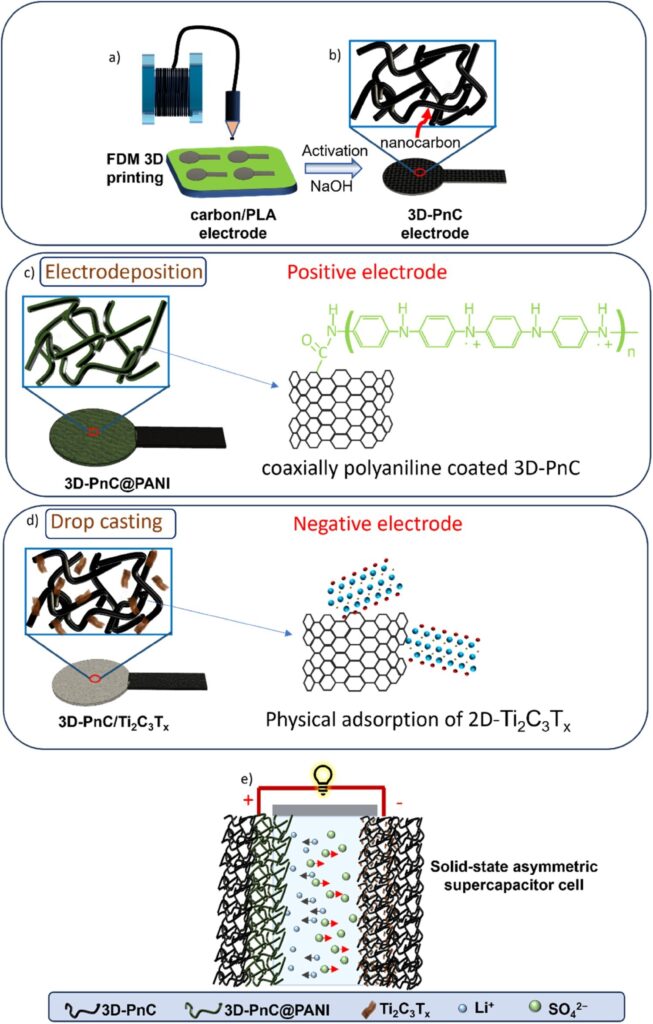
3D printing has emerged as an attractive manufacturing technique in supercapacitor electrodes owing to the precise and customisable fabrication of complex electrode designs, enhancing the performance and efficiency of the device. Despite the advantages, 3D-printed electrodes are limited by their low conductivity and electrochemical properties, predominantly due to the lack of availability of suitable conductive …

MXene and polyaniline coated 3D-printed carbon electrode for asymmetric supercapacitor Read More »

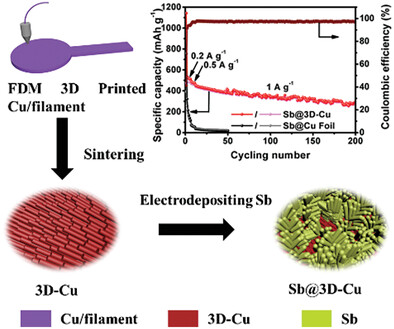
3D-Printed Nanostructured Copper Substrate Boosts the Sodiated Capability and Stability of Antimony Anode for Sodium-Ion Batteries

Sodium-ion batteries (SIBs) represent a viable substitute to lithium-ion batteries due to their affordability and resource abundance. For SIBs, antimony (Sb) shows potential as anode material but is impeded by the high volumetric variations. Here the challenges of Sb sodium storage by introducing the nanostructured Cu substrate for enhanced Sb adhesion and morphology optimization is …

3D-Printed Nanostructured Copper Substrate Boosts the Sodiated Capability and Stability of Antimony Anode for Sodium-Ion Batteries Read More »

Heterolayered carbon allotrope architectonics via multi-material 3D printing for advanced electrochemical devices

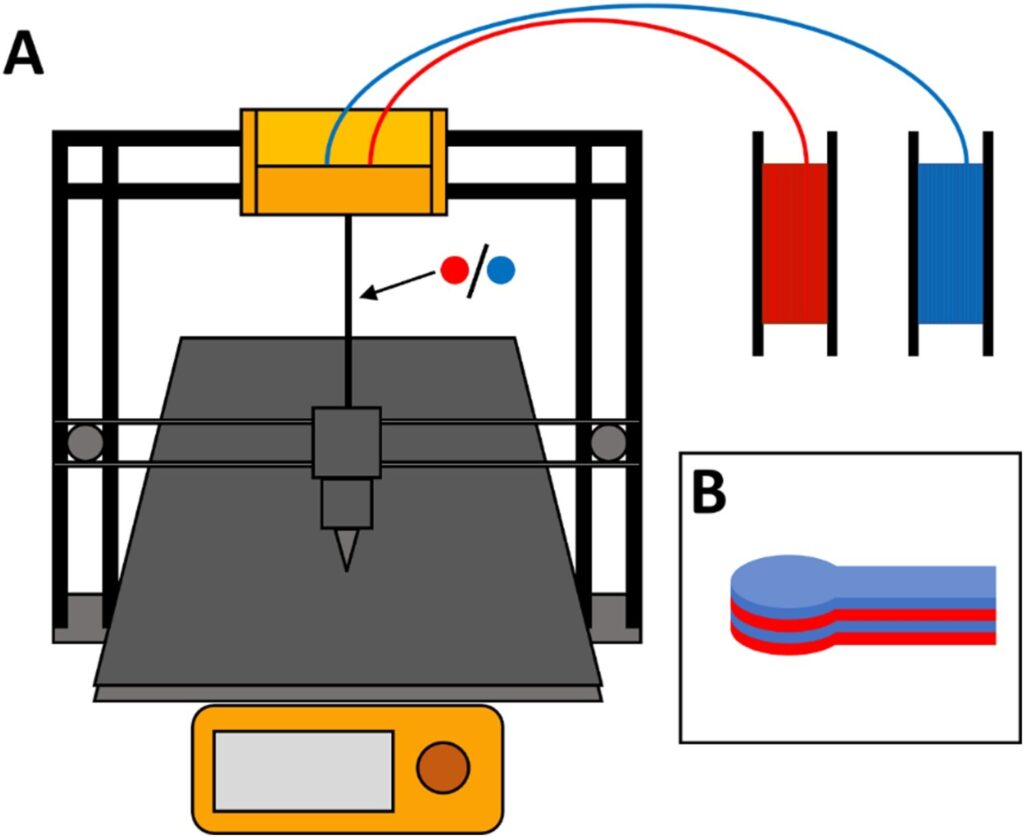
3D printing has become a powerful technique in electrochemistry for fabricating electrodes, thanks to readily available conductive nanocomposite filaments, such as those based on carbon fillers (i.e., carbon nanotubes (CNTs) or carbon black (CB)) within an insulating polymeric matrix like polylactic acid (PLA). Inspired by inorganic heterostructures that enhance the functional characteristics of nanomaterials, we …

Heterolayered carbon allotrope architectonics via multi-material 3D printing for advanced electrochemical devices Read More »

The capacitance and electron transfer of 3D-printed graphene electrodes are dramatically influenced by the type of solvent used for pre-treatment

3D-printing (or additive manufacturing) is presently an emerging technology that promises to reshape traditional manufacturing processes. The electrochemistry field can certainly take advantage of this fabrication tool for sensing and energy-related applications. Polymer/graphene filaments commonly used for the fabrication of 3D-printed electrodes show poor electrochemistry in the native state, requiring post-fabrication activation procedures. In the …

The capacitance and electron transfer of 3D-printed graphene electrodes are dramatically influenced by the type of solvent used for pre-treatment Read More »