Keyword Author: Amperometry

Graphene based nanomaterials as electrochemical detectors in Lab-on-a-chip devices

Graphene related materials have received significant attention as new and advantageous materials for electrochemistry. Here we present an evaluation of graphene oxide amperometric detectors in microfluidics devices and we compare the results to those obtained at graphite microparticles and bare glassy carbon electrodes. We evaluate the influence on peak currents (sensitivity) and peak width (resolution …

Graphene based nanomaterials as electrochemical detectors in Lab-on-a-chip devices Read More »

Effects of heterogeneous electron-transfer rate on the resolution of electrophoretic separations based on microfluidics with end-column electrochemical detection

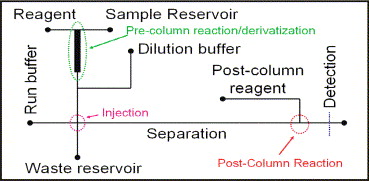
We demonstrate here that the electrode kinetics of an electrochemical detector contributes greatly to the resolution of the analyte bands in microchip electrophoresis systems with amperometric detection. The separation performance in terms of resolution and theoretical plate number can be improved and tailored by selecting or modifying the working electrode and/or by controlling the detection …

Effects of heterogeneous electron-transfer rate on the resolution of electrophoretic separations based on microfluidics with end-column electrochemical detection Read More »

New materials for electrochemical sensing VII. Microfluidic chip platforms

This overview covers important aspects of microfluidic chip platforms as new materials for electrochemical (EC) sensing. It describes important trends in constructing detectors and their electronics on microfluidic chip platforms, the importance of selecting appropriate detector materials, and the different detection modes in on-chip amperometry, conductometry and potentiometry. We pay particular attention to the latest …

New materials for electrochemical sensing VII. Microfluidic chip platforms Read More »

New materials for electrochemical sensing VI: Carbon nanotubes

Carbon nanotubes (CNTs) combine in a unique way high electrical conductivity, high chemical stability and extremely high mechanical strength. These special properties of both single-wall (SW) and multi-wall (MW) CNTs have attracted the interest of many researchers in the field of electrochemical sensors. This article demonstrates the latest advances and future trends in producing, modifying, …

New materials for electrochemical sensing VI: Carbon nanotubes Read More »