Keyword Author: Additive manufacturing

Integrated free-standing WS2 3D-printed carbon supercapacitor with solid state electrolyte

There is a huge need for energy storage devices due to the depletion of natural gas and the increasing requirement for portable electronic gadgets. Fused deposition modeling (FDM) 3D-printing has drawn tremendous interest for the fabrication of batteries and supercapacitors (SCs) due to its tabletop manufacturing technique, bespoke design, fast prototyping and user-friendly process. However, …
Integrated free-standing WS2 3D-printed carbon supercapacitor with solid state electrolyte Read More »

2D Methyl Germanane Enhanced 3D Printed Photoelectrodes

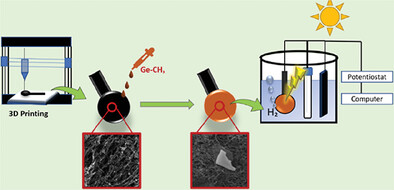
3D printing is a cutting-edge technology, that allows the printing of 3D objects according to the design provided. Nanocarbon electrodes that can be fabricated using 3D printing technology, suffer from a lack of required properties. For enhancing the photoelectrochemical properties of 3D printed electrodes, functionalized germanenes, belonging to the family of 2D materials are used …

2D Methyl Germanane Enhanced 3D Printed Photoelectrodes Read More »

3D-Printed Nanostructured Copper Substrate Boosts the Sodiated Capability and Stability of Antimony Anode for Sodium-Ion Batteries

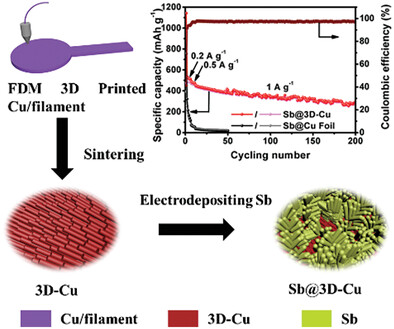
Sodium-ion batteries (SIBs) represent a viable substitute to lithium-ion batteries due to their affordability and resource abundance. For SIBs, antimony (Sb) shows potential as anode material but is impeded by the high volumetric variations. Here the challenges of Sb sodium storage by introducing the nanostructured Cu substrate for enhanced Sb adhesion and morphology optimization is …

3D-Printed Nanostructured Copper Substrate Boosts the Sodiated Capability and Stability of Antimony Anode for Sodium-Ion Batteries Read More »

Heterolayered carbon allotrope architectonics via multi-material 3D printing for advanced electrochemical devices

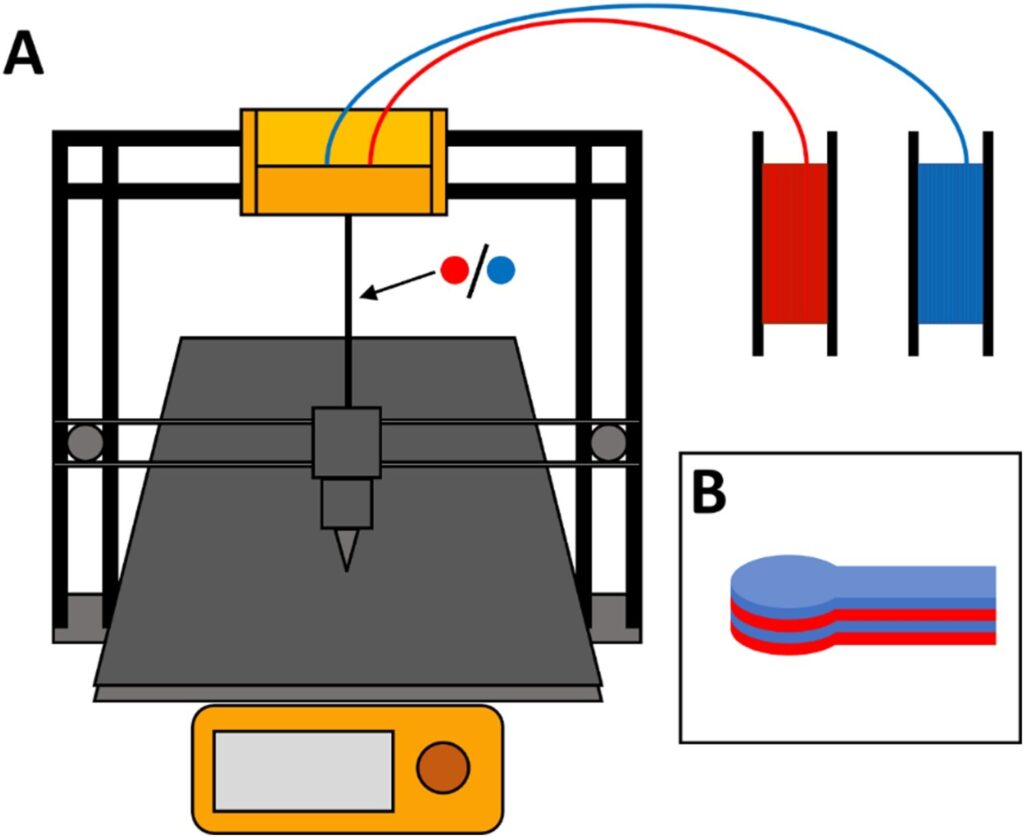
3D printing has become a powerful technique in electrochemistry for fabricating electrodes, thanks to readily available conductive nanocomposite filaments, such as those based on carbon fillers (i.e., carbon nanotubes (CNTs) or carbon black (CB)) within an insulating polymeric matrix like polylactic acid (PLA). Inspired by inorganic heterostructures that enhance the functional characteristics of nanomaterials, we …

Heterolayered carbon allotrope architectonics via multi-material 3D printing for advanced electrochemical devices Read More »

Genosensing on a 3D-printed nanocarbon electrode

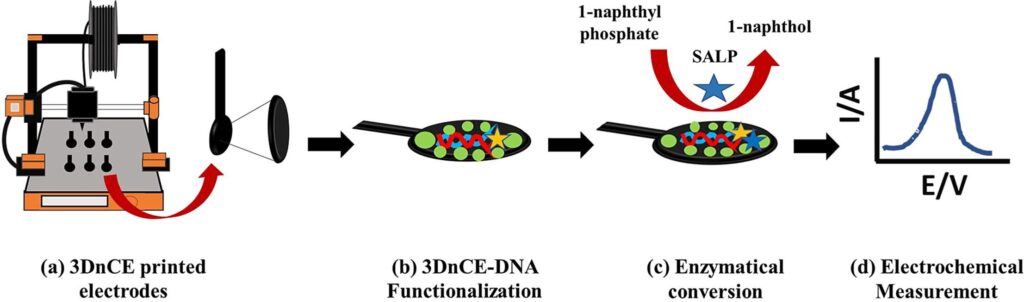
In this paper we present the characterization of 3D-printed nanocarbon electrodes (3DnCes) and their application in electrochemical enzyme-linked detection of DNA hybridization. The approach takes advantage of a facile procedure based on adsorption of target DNA on the electrode surface followed by hybridization with a biotinylated probe and binding of streptavidin–alkaline phosphatase conjugate. The alkaline …

Genosensing on a 3D-printed nanocarbon electrode Read More »

Green activation using reducing agents of carbon-based 3D printed electrodes: Turning good electrodes to great

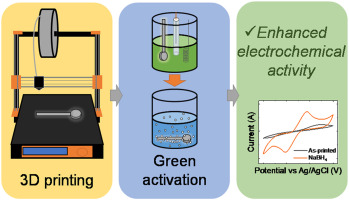
3D printing of carbon-based nanocomposites, which combine the electrical properties of carbon additives with the benefits of thermoplastics, has emerged as a promising route towards rapid and low-cost manufacturing of customised-shaped electronic devices with minimised waste. However, their poor electrical activity in their pristine state makes activation post-treatments mandatory to reduce the amount of insulating …

Green activation using reducing agents of carbon-based 3D printed electrodes: Turning good electrodes to great Read More »

3D-printed Ag/AgCl pseudo-reference electrodes

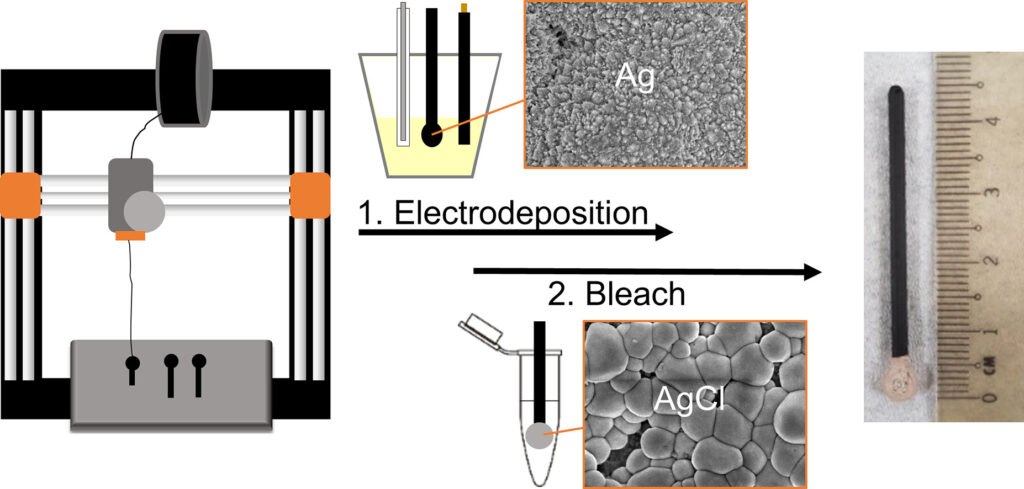
Three-dimensional (3D) printing offers the advantages of customisation, reproducibility and rapid production. In parallel, there is a demand for electrochemical components designed for miniaturisation or customisation of devices. Herein we report a straightforward, fast and simple method to prepare an Ag/AgCl pseudo-reference electrode primarily based on 3D printing using a graphene/polylactic acid filament. The fabrication …

3D-printed Ag/AgCl pseudo-reference electrodes Read More »

3D-printed Electrodes for Sensing of Biologically Active Molecules

3D printing (additive manufacturing) is currently an emerging technology that could revolutionize the traditional manufacturing process. The application of 3D printing technology has been examined in many different fields including manufacturing, science, medicine, and electronics. Another application of 3D printing technology which holds promising potential is fabrication of electrochemical sensors and transducers. Electroanalytical devices hold …

3D-printed Electrodes for Sensing of Biologically Active Molecules Read More »

(Bio)Analytical chemistry enabled by 3D printing: Sensors and biosensors

3D printing has revolutionized the concept of object manufacturing, making an enormous impact on industry and economy. The technology has found a niche in countless fields, including scientific research. It has rendered practical solutions to scientific problems by offering tailored-shaped devices with exquisite control in design and geometry and through the versatility of printable materials. …

(Bio)Analytical chemistry enabled by 3D printing: Sensors and biosensors Read More »

Helical 3D-Printed Metal Electrodes as Custom-Shaped 3D Platform for Electrochemical Devices

3D-printing represents an emerging technology that can revolutionize the way object and functional devices are fabricated. Here the use of metal 3D printing is demonstrated to fabricate bespoke electrochemical stainless steel electrodes that can be used as platform for different electrochemical applications ranging from electrochemical capacitors, oxygen evolution catalyst, and pH sensor by means of …

Helical 3D-Printed Metal Electrodes as Custom-Shaped 3D Platform for Electrochemical Devices Read More »