Keyword Author: 3D-printing

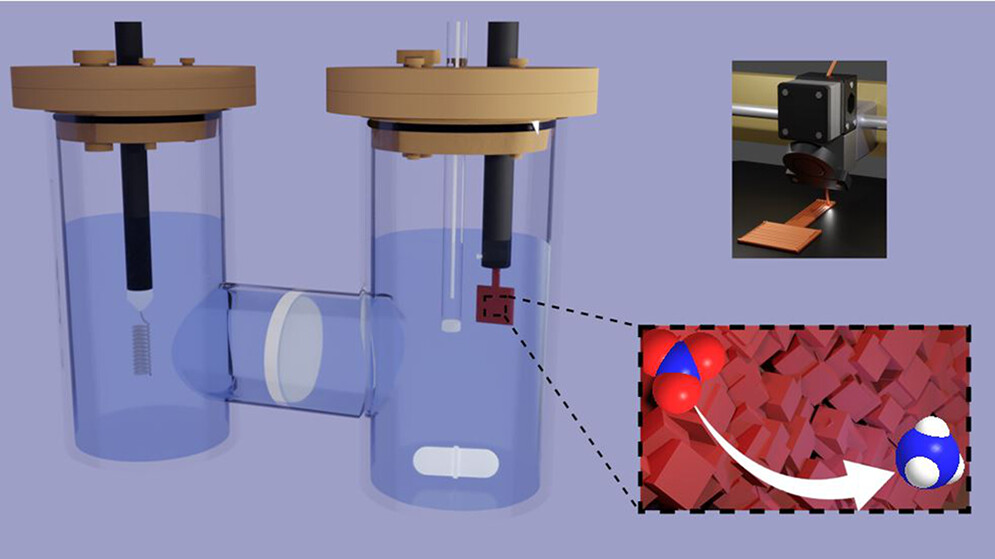
Copper 3D-Printed Electrodes for Ammonia Electrosynthesis via Nitrate Reduction

Ammonia is critical to the world economy. However, nowadays the production of ammonia is exclusively carried out by the well-known Haber–Bosch process, which is an energy-intensive process that leads to a large amount of CO2 emissions. The search for alternative ammonia production routes is mandatory for a sustainable and zero emissions future economy. Electrochemical nitrate-to-ammonia …

Copper 3D-Printed Electrodes for Ammonia Electrosynthesis via Nitrate Reduction Read More »
MXene-functionalised 3D-printed electrodes for electrochemical capacitors

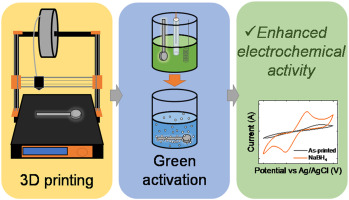
3D printing is a manufacturing technique that can be used to produce electrochemical capacitors with customised shapes and minimal material waste. However, the range of carbon-additive filaments currently commercially available is limited, resulting in 3D-printed electrodes with a poor capacitive performance due to their high thermoplastic content. Herein, a novel approach is presented for enhancing …

MXene-functionalised 3D-printed electrodes for electrochemical capacitors Read More »

The capacitance and electron transfer of 3D-printed graphene electrodes are dramatically influenced by the type of solvent used for pre-treatment

3D-printing (or additive manufacturing) is presently an emerging technology that promises to reshape traditional manufacturing processes. The electrochemistry field can certainly take advantage of this fabrication tool for sensing and energy-related applications. Polymer/graphene filaments commonly used for the fabrication of 3D-printed electrodes show poor electrochemistry in the native state, requiring post-fabrication activation procedures. In the …

The capacitance and electron transfer of 3D-printed graphene electrodes are dramatically influenced by the type of solvent used for pre-treatment Read More »

Multimaterial 3D-Printed Water Electrolyzer with Earth-Abundant Electrodeposited Catalysts

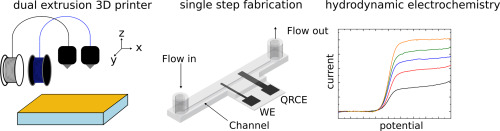
Additive manufacturing (AM) is reaching a stage of development that enables high throughput fabrication of end products/devices. An important contribution to the advancement of this technology is given by the possibility to combine different materials into a single printing process or integrate diverse technologies for the fabrication of different components. Here we show how a …

Multimaterial 3D-Printed Water Electrolyzer with Earth-Abundant Electrodeposited Catalysts Read More »

3D Printed Graphene Electrodes’ Electrochemical Activation

Three-dimensional (3D) printing technologies are emerging as an important tool for the manufacturing of electrodes for various electrochemistry applications. It has been previously shown that metal 3D electrodes, modified with metal oxides, are excellent catalysts for various electrochemical energy and sensing applications. However, the metal 3D printing process, also known as selective laser melting, is …

3D Printed Graphene Electrodes’ Electrochemical Activation Read More »

Additive manufacturing of electrochemical interfaces: Simultaneous detection of biomarkers

3D-printed stainless steel helical shaped electrodes with or without surface modification with a gold (Au) film are tested as novel electrode materials for the electrochemical detection of ascorbic acid and uric acid in aqueous solutions. Their performance in terms of sensitivity, selectivity and reproducibility is evaluated and compared to conventional glassy carbon electrode (GCE). Owing …

Additive manufacturing of electrochemical interfaces: Simultaneous detection of biomarkers Read More »

Self-Contained Polymer/Metal 3D Printed Electrochemical Platform for Tailored Water Splitting

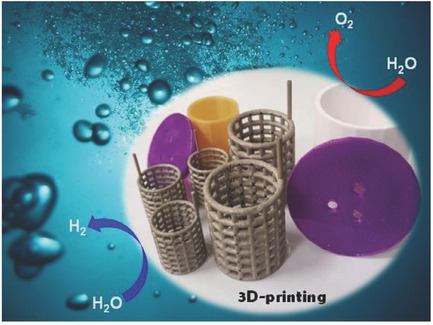
The enormous advancements made recently in additive manufacturing require parallel development of new printable materials with particular focus on so-defined functional materials. Functional materials have specific properties that are useful for the fabrication of active devices such as sensors, electronic components, catalytic reactors, etc. It is shown here that the combination of standard 3D-printing technologies …

Self-Contained Polymer/Metal 3D Printed Electrochemical Platform for Tailored Water Splitting Read More »

(Bio)Analytical chemistry enabled by 3D printing: Sensors and biosensors

3D printing has revolutionized the concept of object manufacturing, making an enormous impact on industry and economy. The technology has found a niche in countless fields, including scientific research. It has rendered practical solutions to scientific problems by offering tailored-shaped devices with exquisite control in design and geometry and through the versatility of printable materials. …

(Bio)Analytical chemistry enabled by 3D printing: Sensors and biosensors Read More »

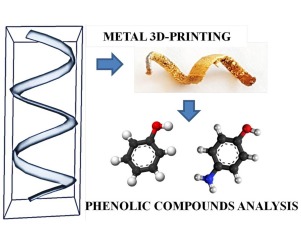
3D-printed metal electrodes for electrochemical detection of phenols

3D printed metal electrode modified by means of electroplating methodologies was tested and compared with conventional glassy carbon (GC) electrode for the individual and simultaneous electrochemical detection of phenol and p-aminophenol (p-AP) in aqueous solution via cyclic and differential pulse voltammetry. The 3D printed gold-plated electrode produced two distinct oxidation peaks for phenol and p-AP …

3D-printed metal electrodes for electrochemical detection of phenols Read More »

3D-printed Metal Electrodes for Heavy Metals Detection by Anodic Stripping Voltammetry

Heavy metals, being one of the most toxic and hazardous pollutants in natural water, are of great public health concern. Much effort is still being devoted to the optimization of the electroanalytical methods and devices, particularly for the development of novel electrode materials in order to enhance selectivity and sensitivity for the analysis of heavy …

3D-printed Metal Electrodes for Heavy Metals Detection by Anodic Stripping Voltammetry Read More »

Helical 3D-Printed Metal Electrodes as Custom-Shaped 3D Platform for Electrochemical Devices

3D-printing represents an emerging technology that can revolutionize the way object and functional devices are fabricated. Here the use of metal 3D printing is demonstrated to fabricate bespoke electrochemical stainless steel electrodes that can be used as platform for different electrochemical applications ranging from electrochemical capacitors, oxygen evolution catalyst, and pH sensor by means of …

Helical 3D-Printed Metal Electrodes as Custom-Shaped 3D Platform for Electrochemical Devices Read More »