Artificial Intelligence Meets Micro/Nanorobotics

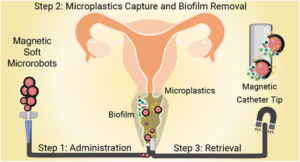
The health of the female reproductive system is increasingly threatened by emerging environmental contaminants that cause potential bacterial infections, cancer, and fertility problems. Yet effective strategies for the localized removal of these contaminants remain largely unexplored. Among these contaminants, microplastics have emerged as a major global health concern, with growing evidence of their accumulation in human tissues and associated with infectious diseases, carcinogenesis, cellular aging, and infertility due to direct or indirect contact with synthetic fabrics, plastic kitchenware, and disposable feminine hygiene products. Despite these risks, the removal of retained microplastics, particularly from sensitive reproductive environments, remains a significant challenge in biomedical research. Here, we report an image-guided magnetic soft microrobot platform designed for targeted microplastic capture and biofilm eradication within the female reproductive system. Magnetic soft microrobots were fabricated using a droplet solidification method and functionalized with a polydopamine coating via self-polymerization to enhance the surface adhesion and capture efficiency. Real-time visualization and precise navigation were enabled under X-ray fluoroscopy through the incorporation of tantalum-based contrast agents. Functionally, the magnetic soft microrobots inhibited up to 67% of biofilm growth and achieved microplastic capture efficiencies of up to 80% in phosphate-buffered saline and 50% in simulated vaginal fluid, demonstrating a robust performance under biologically relevant conditions. This study demonstrates the integration and application of image-guided microrobots for the removal of microplastics and biofilms in the female reproductive system, offering a promising strategy for minimally invasive interventions to protect reproductive health from environmental pollutants.
Artificial Intelligence Meets Micro/Nanorobotics

Translational Application of Biomedical Microrobots in Female Reproductive System
Microrobots for Antibiotic-Resistant Staphylococcus aureus Skin Colony Eradication