Printing technologies for monitoring crop health

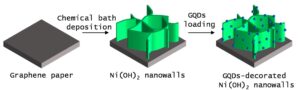
Water splitting is a critical process for sustainable energy transition, involving the electrolysis of water into its constituent elements, hydrogen and oxygen. In this study, we demonstrate the superior electrocatalytic activity of graphene quantum dots (GQDs)-decorated nickel hydroxide (Ni(OH)2) nanostructures for the oxygen evolution reaction (OER) in alkaline media. Ni(OH)2 nanowalls are synthesized on graphene paper substrates by chemical bath deposition (CBD) and uniformly decorated with GQDs. Precise optimization of the GQDs amount indicates that a low number of GQDs offers limited improvement of the OER, while a high number is unfavorable due to the minor exposed surface of the electrocatalyst. Instead, an intermediate quantity of GQDs significantly enhances the OER performance metrics, leading to a low overpotential at 10 mA cm−2 current density (η10) of 308 mV and a Tafel slope of 53 mV dec−1, rapid electron transfer, high turnover frequency (TOF) of 5.5 × 10⁻² s−1 at 350 mV overpotential, large electrochemically active surface area (ESCA) of 145 cm2, good durability, and good cycling stability in 1 M KOH electrolyte (pH 14). Mott–Schottky analysis sheds light on the OER mechanism, revealing the role of GQDs in increasing the surface hole density of Ni(OH)2, thereby boosting the OER efficiency.
Printing technologies for monitoring crop health

Laser-Assisted Mo2C-Derived Patterned Oxide for Highly Selective Room Temperature Ammonia Sensor for Food Spoilage Monitoring
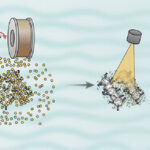
Reconfigurable Self-Assembling Photocatalytic Magnetic Liquid Metal Microrobot Swarm for Microplastic Capture and Degradation