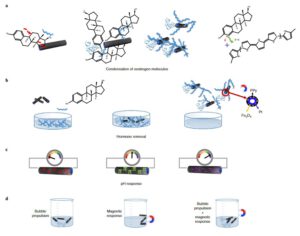
The occurrence of synthetic and natural hormones in an aqueous environment poses significant risks to humans because of their endocrine-disrupting activity. Autonomous self-propelled and remotely actuated nano/microrobots have emerged as a new field that encompasses a wide range of potential applications, including sensing, detection and elimination/degradation of emerging pollutants. In this work, we develop programmable polypyrrole-based (PPy, outer functional layer) microrobots incorporated with a Pt catalytic layer and paramagnetic iron nanoparticles (Fe3O4) to provide self-propulsion and a magnetic response for the highly efficient removal of oestrogenic pollutants. As the pH of the tested water alters, the surface charge of PPy/Fe3O4/Pt microrobots gradually changes, leading to affinity modulation. As microrobots move inside the solution, they collect oestrogen fibres and subsequently weave macroscopic webs on the surface. Our results suggest that motion-controllable microrobots with adjustable surface chemistry could provide a suitable platform for the highly efficient removal of hormonal pollutants.