Integrated health monitoring system with flexible asymmetric supercapacitors based on 2D Ti₃C₂ MXene and transitional metal oxides

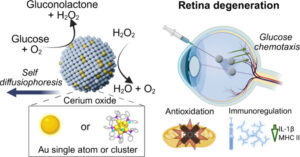
Retinal degeneration poses a growing global health challenge with limited effective treatments. Current options, such as intravitreal injections of therapeutic drugs, are severely constrained by the vitreous humor barrier, a dense, gel-like matrix that limits drug diffusion to the retina. Micro/nanorobots with active propulsion have emerged as promising platforms for targeted drug delivery to overcome biological barriers. Here, we report the design of chemotactic nanorobots that can actively overcome the vitreous humor to target the retina. Single-atom engineering is utilized to construct ultrasmall nanorobots that catalytically convert endogenous glucose into mechanical propulsion, enabling active navigation through the vitreous barrier toward retinal tissues. Both ex vivo tissue and in vivo mouse models confirm the nanorobots’ ability to overcome vitreous viscosity and target retinal cells due to their ultrasmall sizes (less than 10 nm) and active motion. In a mouse model of induced retinal degeneration, these nanorobots exert potent dual antioxidant and immunomodulatory activities, markedly delaying disease progression. Mechanistic studies at the gene expression level further elucidated the molecular basis of these therapeutic effects. These promising findings highlight the potential of single-atom engineered chemotactic nanorobots as effective nanomedicine, paving the way for their application as active drug delivery platforms in noninvasive treatment of ocular diseases.
Integrated health monitoring system with flexible asymmetric supercapacitors based on 2D Ti₃C₂ MXene and transitional metal oxides

Virus Enhanced Microrobots for Biofilm Eradication

MAX phase metal carbide-enabled triboelectric nanogenerator for integrated ammonia generation